域
Character Story & Explanation
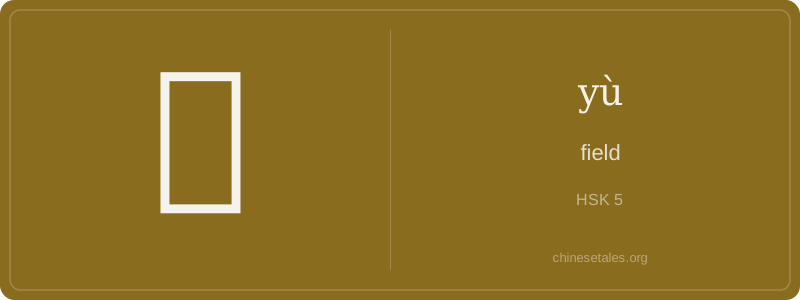
The earliest form of 域 appears on Western Zhou bronze inscriptions as a compound pictograph: a walled enclosure (represented by 囗, a square boundary) containing 土 (earth/soil), with 殳 (a hand holding a weapon-like staff) added later to emphasize control. Over centuries, the enclosing square simplified into the top-left 囗 component, 土 stayed solidly at the bottom, and 殳 evolved into the elegant, slanted strokes on the right — now stylized as ‘or’-shaped hooks and dots. By the seal script era, all three elements were fused into a single, balanced character: boundary + earth + authority = ‘defined territory’.
This visual logic shaped its meaning from day one: in the *Book of Documents* (Shūjīng), 域 described the king’s protected realm — land measured, taxed, and defended. Confucius used it metaphorically in the *Analects* (16.2) when warning rulers not to let their ‘domain of virtue’ shrink through neglect. Even today, the shape whispers its origin: look closely — the 囗 is the wall, the 土 is the ground within, and those final strokes? They’re the watchful gaze (and perhaps the spear) of sovereignty. No wonder it feels weightier than mere ‘area’.
At its heart, 域 (yù) isn’t just ‘field’ in the agricultural sense — it’s a *bounded space*, a territory with edges: physical, conceptual, or digital. Think of it as ‘domain’ with attitude: a sovereign zone you enter, define, or defend. Its radical 土 (tǔ, ‘earth’) anchors it in the tangible world, while the right side 殳 (shū, an ancient weapon-handling component) hints at historical enforcement — this wasn’t just land; it was land *guarded*. In modern usage, it rarely stands alone. You’ll almost always see it in compounds like 领域 (lǐng yù, ‘field/domain’) or 疆域 (jiāng yù, ‘territory’), where it adds gravitas and formality.
Grammatically, 域 never functions as a verb or adjective — it’s strictly a noun, and almost always appears in two-syllable words. Learners often mistakenly use it like English ‘field’ in isolation (e.g., *‘I work in computer field’ → *‘我在计算机域工作’), but that’s unnatural. Instead, say 我在计算机领域工作 (wǒ zài jì suàn jī lǐng yù gōng zuò). Also, avoid confusing it with 地 (dì, ‘ground’) or 区 (qū, ‘area’) — 域 implies intentionality, scope, and sometimes authority, not just location or geography.
Culturally, 域 carries quiet weight: in classical texts like the *Zuo Zhuan*, it denoted feudal fiefdoms — spaces defined by ritual, loyalty, and walls. Today, that legacy echoes in phrases like 网络域 (wǎng luò yù, ‘network domain’) or 学术域 (xué shù yù, ‘academic domain’), where ‘domain’ implies not just subject matter, but a community with shared rules and boundaries. The biggest trap? Over-translating ‘field’ — if your English sentence says ‘field of study’, reach for 领域, not 域 alone.