堆
Character Story & Explanation
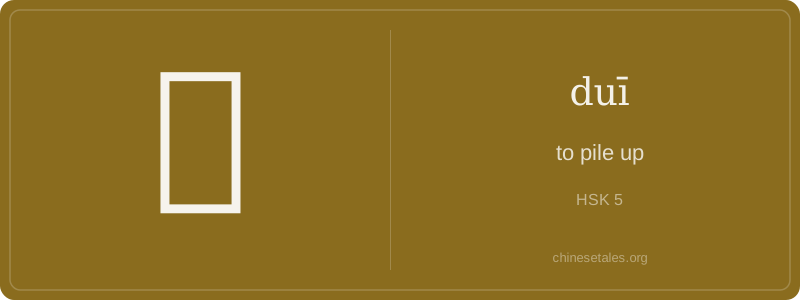
The earliest form of 堆 appears in bronze inscriptions as a combination of 土 (earth) and 谁 (shuí, later simplified to 几 — a stylized 'table' or 'platform') — but wait! That ‘who’ is actually a phonetic loan. The original oracle bone script didn’t exist for 堆, but by the Warring States period, scribes drew it as 土 + 佳 (jiā), then evolved into 土 + 堕 (duò, 'to fall'), before settling on 土 + 堆’s current right side (a phonetic component once pronounced *tuəi). Visually, imagine earth heaped onto a low platform — each stroke mimics the bulging, uneven shape of a mound: the horizontal strokes curve outward, the dot and捺 (nà) sweep downward like collapsing soil.
This earth-on-platform image stuck. In the Shuōwén Jiězì (121 CE), Xu Shen defined 堆 as 'a mound of earth' — a topographic term for artificial hills built for defense or ritual. Over time, its meaning broadened from literal earthen mounds (like burial tumuli) to any accumulated mass — grain, firewood, or even abstract things like debts (债堆). By Tang poetry, Du Fu wrote of 'clouds piling up at the mountain pass' (云堆), showing how early the verb sense emerged. The character’s visual weight — eleven strokes, thick horizontal lines, and that heavy捺 — still echoes its ancient burden: matter gathering, settling, and asserting presence.
Think of 堆 (duī) as the Chinese verb for 'to pile up' — but not just neatly, like stacking books. It’s about accumulation with a slight sense of disorder, weight, or even excess: piles of laundry, mountains of paperwork, heaps of gossip. The radical 土 (tǔ, 'earth/soil') anchors it in the physical world — this isn’t abstract piling; it’s tangible, grounded, often messy. You’ll see it used both transitively ('She piled up the boxes') and intransitively ('The snow piled up'), and crucially, as a measure word (like 'a pile of') — e.g., 一堆书 (yī duī shū, 'a pile of books').
Grammatically, 堆 shines in resultative complements (e.g., 堆满 — 'pile until full') and passive constructions (被堆得… — 'was piled so high that…'). Learners often mistakenly use it where English says 'stack' (which leans toward vertical order) — but 堆 implies bulk, density, and sometimes mild chaos. You wouldn’t say 堆起一摞整齐的瓷器 (duī qǐ yī luò zhěngqí de cíqì) — that’s better as 叠 (dié). Instead, 堆 fits perfectly in 'The street was piled high with fallen leaves' (街上堆满了落叶).
Culturally, 堆 carries subtle connotations of abundance bordering on overwhelm — think of festival scenes with piles of dumplings or New Year red envelopes heaped on a table. It’s also idiomatic in expressions like 堆砌 (duīqì, 'to pile up rhetorically' — i.e., overuse flowery language), revealing how the physical act metaphorically extends to language and thought. A common error? Confusing it with 攒 (zǎn, 'to save up' — emotionally charged, intentional) — 堆 is neutral, visual, and often unintentional.