涂
Character Story & Explanation
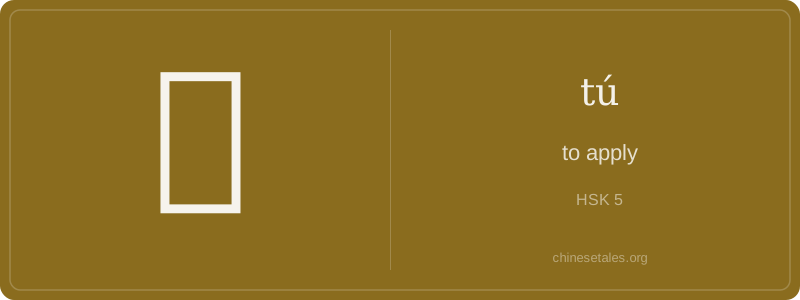
The earliest form of 涂 appears in bronze inscriptions as a combination of 水 (water) and 余 (yú, a phonetic component), but its oracle bone roots suggest something more vivid: a stylized depiction of liquid dripping onto a surface, with three flowing strokes on the left (the modern 氵 radical) representing water or paste, and the right side evolving from 余—a character originally picturing a tree stump with branches, later repurposed for sound. Over centuries, the 'stump' simplified into 余’s current shape: a horizontal stroke, a vertical stroke, then two diagonal strokes beneath—totaling 10 strokes, matching the count of fingers you might use to *smear* something across a wall.
This visual logic anchored its meaning: to spread liquid or semi-liquid matter onto a surface. By the Warring States period, 涂 appeared in texts like the *Zuo Zhuan*, describing officials ‘涂金’ (tú jīn, ‘gilding’) temple beams—literally ‘applying gold leaf’ with adhesive paste. Later, Confucian scholars used 涂 to describe moral ‘application’ (e.g., 涂德, tú dé, ‘imparting virtue’), extending the physical act into pedagogy. Even today, the character’s structure whispers its origin: three water drops (氵) + the ‘remainder’ (余) of what’s left *after* spreading—like the thin film of paint that remains once you’ve swept your brush across the canvas.
Think of 涂 (tú) as the Chinese equivalent of 'slathering'—not just 'applying,' but doing it with intention, texture, and sometimes even a little mess. Unlike English verbs like 'put on' or 'apply,' which are often neutral, 涂 carries tactile weight: you *涂* paint, *涂* lipstick, *涂* ointment—always with a surface, always with something viscous or spreadable. It’s rarely used for abstract or digital actions (no '涂 an email'!), and never for permanent attachment like 'glue' or 'screw.' You wouldn’t say *涂* a nail—it’s *钉* (dīng); you wouldn’t *涂* a password—it’s *设置* (shèzhì). That physicality is baked into its water radical 氵, hinting at fluid media.
Grammatically, 涂 is almost always transitive and action-oriented: subject + 涂 + object + (on) surface. It pairs naturally with measure words like 层 (céng, 'layer') or 厚厚地 (hòuhòu de, 'thickly'). A classic beginner mistake? Using 涂 instead of 擦 (cā, 'to wipe') — imagine proudly announcing 'I *涂* my face' when you meant 'I wiped my face'! Another trap: confusing it with 涂改 (túgǎi, 'to alter/forge'), where 涂 shifts from 'apply' to 'cover up'—a subtle but critical semantic pivot rooted in historical censorship practices.
Culturally, 涂 appears in loaded contexts: 涂鸦 (túyā, 'graffiti') literally means 'scribbling over,' echoing ancient officials who'd *涂* over inconvenient edicts; 涂炭 (tútàn, 'burnt charcoal') is a classical idiom for devastation—evoking scorched earth, not art supplies. Learners often miss that 涂 can imply erasure or distortion, not just decoration. So yes, you *涂* sunscreen—but you also *涂* over truth. Handle with care.