尘
Character Story & Explanation
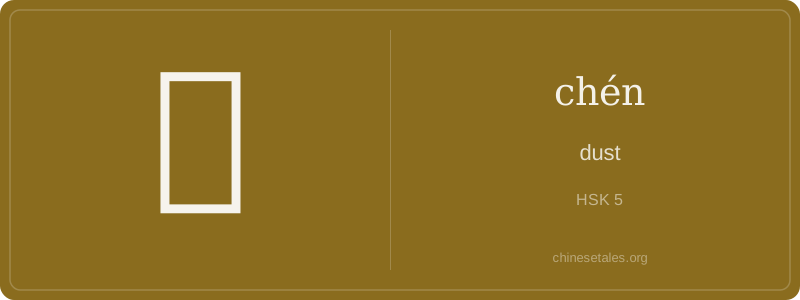
The earliest form of 尘 appears in bronze inscriptions as two 'small' (小) characters stacked above each other — ️→小 + 小 — representing particles of dust kicked up by wind or footsteps. Why two 小? Because dust isn’t one thing — it’s countless tiny things, too small to name individually. Over centuries, the top 小 simplified into the three dots (⺌) we see today, while the bottom 小 remained intact, giving us the modern six-stroke structure: ⺌ + 小. This evolution wasn’t arbitrary — it preserved the core idea of multiplicity and minuteness.
By the Warring States period, 尘 had already leapt beyond literal dust. Zhuangzi used 尘 in the phrase 尘垢 (chén gòu, 'dust and grime') to symbolize worldly illusions obscuring true nature. In Buddhist sutras translated during the Han dynasty, 尘 became one of the ‘six sense objects’ (六尘 liù chén) — sights, sounds, smells, etc. — all considered transient ‘dust’ clouding enlightenment. The visual doubling of 小 thus became philosophical: reality is made of infinite, fleeting fragments — and this character holds them all in six strokes.
Imagine walking into an old Beijing courtyard after a dry spring wind — the air hangs thick with fine, golden dust swirling around your ankles. That’s 尘 (chén): not just ‘dust’ as in dirt, but the quiet, pervasive, almost poetic residue of time, movement, and impermanence. In Chinese, 尘 carries weight beyond physics — it evokes transience (尘世 chénshì, 'the dusty world' = secular life), humility ('a grain of dust'), and even spiritual impurity (as in Buddhist texts where 尘 represents sensory distractions). It’s never neutral: 尘 always whispers something about fragility or ephemerality.
Grammatically, 尘 rarely stands alone in speech — you’ll almost always see it in compounds like 尘土 (chén tǔ, 'dust and soil') or 风尘 (fēng chén, 'wind-dust' = hardship or the bustling world). As a noun, it’s uncountable; you don’t say *yī gè chén* — instead, use measure words like yī céng chén (a layer of dust) or yī piào chén (a puff of dust). Learners often mistakenly treat it like English ‘dust’ and try to pluralize it or use it adjectivally without a compound — but 尘 itself is never an adjective. You’d say 满是灰尘 (mǎn shì huī chén, 'full of dust'), not *尘满*.
Culturally, 尘 appears everywhere from Tang poetry ('dust covers the ancient road') to modern slogans like 一尘不染 (yī chén bù rǎn, 'not a speck of dust' = impeccably clean or morally pure). A classic pitfall? Confusing 尘 with 土 (tǔ, 'soil') or 灰 (huī, 'ash') — but 尘 is finer, airborne, and metaphorically loaded. It’s the dust that settles on your heart, not just your shelf.