壁
Character Story & Explanation
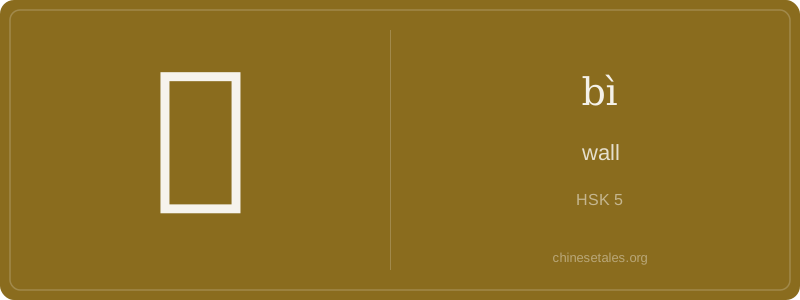
The earliest form of 壁 appears in bronze inscriptions (c. 1000 BCE) as a pictograph showing two parallel vertical lines (representing upright wall panels) flanking a central element — originally a stylized ‘玉’ (jade) or ‘辟’ (to ward off), later simplified into ‘辟’. The left side was consistently ‘土’, signaling earth-based construction: rammed-earth walls were foundational to Shang and Zhou defense. Over centuries, the right side evolved from complex ritual glyphs into the phonetic component 辟 (bì), which both hints at pronunciation and preserves the idea of ‘warding off danger’ — walls as protective boundaries.
This dual nature — physical structure + symbolic shield — persisted through classical texts: in the *Zuo Zhuan*, ‘壁’ refers to military encampments fortified with earthen ramparts; in Tang poetry, ‘断壁残垣’ (duàn bì cán yuán) laments broken walls and ruined courtyards, evoking loss and time’s erosion. Interestingly, the character retained its ‘earth’ radical even as walls became brick and tile — honoring origin over material. Its stroke count (16) mirrors the meticulous layering of traditional rammed-earth technique: each stroke like a compacted stratum, building unshakeable meaning from the ground up.
Imagine you’re standing in an ancient Chinese courtyard: the sun glints off a smooth, plastered wall (壁) surrounding the compound — not just any wall, but one that defines space, protects privacy, and even bears calligraphy. In Chinese, 壁 isn’t just ‘wall’ as inert architecture; it’s a boundary with presence — think of 壁画 (bì huà, mural) painted *on* it, or 壁橱 (bì chú, built-in wall cabinet) *embedded* in it. It implies verticality, solidity, and intentionality — unlike the generic, neutral 墙 (qiáng), which can mean any wall (even a brick fence or metaphorical barrier).
Grammatically, 壁 rarely stands alone — it’s almost always in compounds (壁炉, 壁虎, 壁挂). You’ll never say *‘this is a bì’* like ‘this is a wall’ in English; instead, it appears in tightly bound nouns or technical terms. Learners often mistakenly use 壁 where 墙 fits better — e.g., saying *‘wǒ de fáng jiān yǒu sān gè bì’* (my room has three walls) sounds unnatural; native speakers say *sān gè qiáng*. 壁 feels literary, architectural, or specialized.
Culturally, 壁 carries scholarly weight: the idiom ‘面壁十年’ (miàn bì shí nián) — ‘facing a wall for ten years’ — evokes Bodhidharma meditating motionless for years at Shaolin, symbolizing relentless focus. Also, note its radical 土 (earth/soil): though modern walls are concrete, the character roots wall-making in packed earth — a reminder that China’s earliest fortifications were rammed-earth ramparts. Confusing 壁 with other ‘wall’ words is the #1 HSK 5 trap — so remember: 壁 = deliberate, vertical, cultural surface; 墙 = general, functional barrier.