寿
Character Story & Explanation
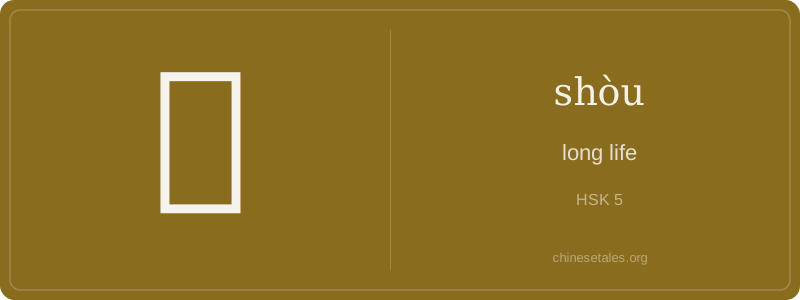
The earliest form of 寿 appears in Western Zhou bronze inscriptions as a complex pictograph: at the top, a hand holding a ritual vessel (often interpreted as a wine cup or sacrificial offering), below it a person kneeling in reverence, and beneath that, the radical 寸 (cùn), representing the hand’s measurement — symbolizing measured, deliberate devotion to sustaining life. Over centuries, the kneeling figure simplified into the upper component (), the vessel morphed into the horizontal strokes, and the hand-measurement base solidified as 寸. By the Han dynasty, the character had settled into its current 7-stroke shape — elegant, balanced, and unmistakably anchored by the 寸 radical.
This evolution reflects how 寿’s meaning deepened from concrete ritual action ('offering to extend life') to abstract virtue ('longevity earned through moral conduct'). In the Book of Rites, 寿 is linked to the Confucian ideal that ‘virtue brings long life’ (德者寿), making it more than biological age — it’s social validation. The 寸 radical isn’t arbitrary: in ancient China, measuring time, land, and even moral worth was done with the hand — so 寿 literally means ‘life measured and honored by the hand of virtue.’ Even today, when elders receive a 寿桃 (peach of longevity), the gesture echoes that ancient hand-off of blessing.
Think of 寿 (shòu) as China’s ‘Longevity Medal’ — not a trophy you win, but one you earn by living well, honoring elders, and staying in harmony with time itself. Unlike English words like 'long life' (which feel abstract or aspirational), 寿 carries warm, ceremonial weight: it’s the character you see on red birthday cakes, embroidered on silk pillows for grandparents, and chanted during ancestral rites. It doesn’t just mean *a long life* — it embodies *blessed, virtuous, socially rooted longevity*, deeply tied to filial piety and cosmic balance.
Grammatically, 寿 is rarely used alone as a verb or noun in modern speech — you won’t say *‘I shòu’* like ‘I live long.’ Instead, it shines in set phrases: as a noun in compounds (寿星, 寿礼), as an adjective-like modifier (寿面), or in formal blessings (祝您长寿!). Learners often mistakenly treat it as a standalone verb (e.g., *‘他寿了’*) — a classic error that sounds like saying ‘He long-lifed!’ in English. Remember: 寿 needs company — it’s a team player in idioms and rituals, not a solo act.
Culturally, 寿 isn’t neutral — it’s auspicious to the point of being almost sacred. You’ll never see it on tombstones (that’s 忌日 or 终); instead, it’s reserved for the *living* — especially celebratory contexts. A fun trap: in calligraphy, 寿 is often written in elaborate, swirling ‘hundred-character 寿’ patterns (百寿图), but the standard printed form has just seven clean strokes — a beautiful tension between exuberant symbolism and minimalist structure.