夕
Character Story & Explanation
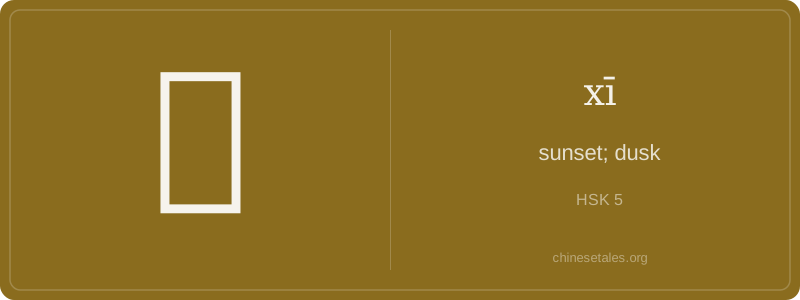
The earliest form of 夕 appears in oracle bone inscriptions as a stylized, downward-curved line with two short, drooping strokes beneath — a pictograph of the sun sinking below the horizon, its rays dimming and bending earthward. Over centuries, the upper curve simplified into the top dot (丶), the middle stroke became the left-falling diagonal (ノ), and the lower stroke hardened into the right-falling hook (㇆) — crystallizing into today’s elegant, economical three-stroke form. Every stroke mirrors descent: no upward movement, no sharp angles — just gravity, softness, and surrender to night.
This visual logic anchored its semantic evolution: from literal ‘setting sun’ → ‘dusk’ → ‘the eve of an event’ (e.g., 除夕, the eve before the New Year). In the Shuō Wén Jiě Zì (121 CE), Xu Shen defined it as ‘the sun about to hide’, confirming its core association with liminality. Classical poets like Li Bai used 夕 to mark emotional turning points — not just time, but the moment when longing begins to deepen. Its shape *is* its meaning: three strokes that don’t rise, don’t resist — they yield, gracefully.
Picture this: 夕 isn’t just ‘sunset’ — it’s the quiet, golden hush *just before* night falls, when shadows stretch long and the sky blushes. In Chinese, it carries poetic weight: not merely a time of day, but a mood of gentle transition, nostalgia, or quiet reflection. It’s rarely used alone in modern speech (you won’t say *‘Today’s 夕 is beautiful’*), but it’s indispensable as a component in compound words and classical expressions — think of it as the ‘dusk DNA’ embedded in dozens of elegant terms.
Grammatically, 夕 functions almost exclusively as a noun or morpheme in compounds — never as a verb or standalone adverb. You’ll find it in time-related nouns like 除夕 (chú xī, Chinese New Year’s Eve) or literary phrases like 夕照 (xī zhào, sunset glow). A classic learner mistake? Using 夕 where you mean 晚 (wǎn, ‘evening’ in everyday contexts) — saying *‘我吃夕饭’* sounds like you’re eating ‘sunset rice’ instead of ‘dinner’. Stick to 夕 in fixed, formal, or poetic contexts; use 晚 for daily life.
Culturally, 夕 evokes deep resonance — especially in poetry and festivals. The character appears in Du Fu’s lines about fading light and is central to 除夕, the most emotionally charged night of the year. Its minimal three strokes conceal millennia of layered meaning: it’s not just twilight — it’s the threshold between worlds, memory and anticipation, warmth and chill. That’s why even advanced learners feel its weight: it’s small, but never light.