委
Character Story & Explanation
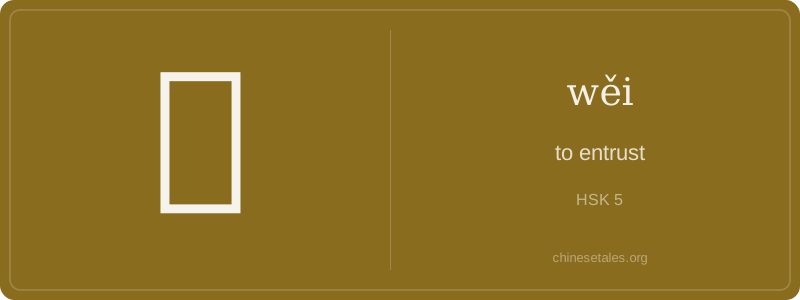
The earliest form of 委 appears in bronze inscriptions as a stylized figure kneeling with arms folded — not a woman, despite the modern 女 radical! Originally, it depicted a person bowing low in submission or deference, their body bent (the top component 尸 represents a crouching figure, not 'corpse'). Over centuries, the lower part evolved into 女 (nǚ, 'woman'), likely due to phonetic borrowing and semantic softening — associating trustworthiness with traditional feminine virtues like reliability and nurturing care. The eight strokes crystallized by the Han dynasty: three for 尸 (crouching shape), five for 女 (the 'woman' radical), visually embodying 'one who bends to serve'.
This bending posture became metaphorical: to bend one’s will in service was to entrust — not just authority, but moral alignment. In the Book of Rites, 委 appears in passages about appointing officials 'with full confidence and solemnity'. Later, in Tang poetry, it acquired the nuance of 'genuinely, truly' (as in 委实), preserving the idea of 'bending fully' — i.e., without reserve — to truth or duty. Even today, the character’s shape whispers humility: the 'woman' radical isn’t about gender, but about yielding with purpose — the very essence of entrusted responsibility.
At its heart, 委 (wěi) isn’t just ‘to entrust’ — it’s the quiet weight of responsibility passed hand-to-hand in a culture that prizes trustworthiness and relational accountability. Unlike English ‘assign’ or ‘delegate’, which can feel transactional, 委 carries subtle moral gravity: when you 委托 someone, you’re not just handing off a task — you’re affirming their competence and integrity. That’s why it appears in formal contexts like government appointments (委任) or legal representation (委托律师), never in casual 'Hey, grab me coffee' situations.
Grammatically, 委 almost always appears in compound verbs — standalone 委 is archaic or literary. You’ll encounter it as 委托 (wěi tuō, to entrust), 委派 (wěi pài, to appoint), or 委任 (wěi rèn, to appoint to office). Crucially, it governs *who* receives the trust, not *what* is entrusted — so you say 委托他办这件事 (entrust *him* with this matter), not 委托这件事. Learners often misplace the object or overuse it where simple 交给 (jiāo gěi) would suffice.
Culturally, 委 reflects Confucian ideals of hierarchical yet reciprocal duty: the one who 委 must choose wisely; the one who is 委ed must act with fidelity. Interestingly, it’s also used in humble self-reference — 我委实不知 (wǒ wěi shí bù zhī, 'I truly do not know') — where 委 intensifies sincerity, echoing its ancient sense of 'bending oneself' to truth. A common mistake? Using 委 alone as a verb — it’s nearly always paired.