姥
Character Story & Explanation
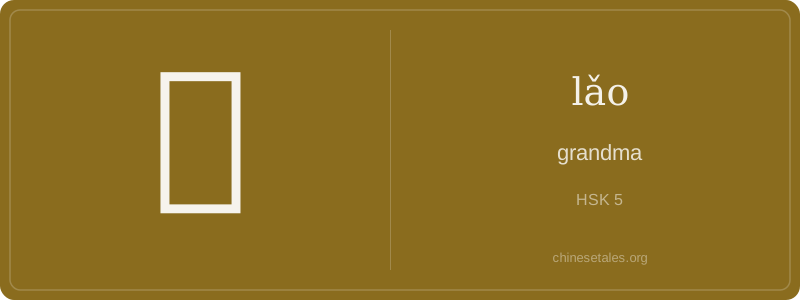
The earliest trace of 姥 appears not in oracle bones but in Han dynasty bronze inscriptions and early clerical script, where it evolved from a compound: the left side 女 (nǚ, ‘woman’) + the right side 老 (lǎo, ‘old’). Look closely — the modern 姥 preserves this logic perfectly: the first three strokes sketch the ‘woman’ radical (a stylized kneeling figure with bent arms), while the remaining six strokes replicate 老’s upper ‘hair’ (丿一) and lower ‘bent back’ (匕) — literally ‘an old woman’. By the Tang dynasty, the character had stabilized into its current structure, with the dot (丶) added above the ‘bent back’ to distinguish it from similar forms.
This visual fusion wasn’t accidental: classical texts like the Shuō Wén Jiě Zì (121 CE) defined 姥 as ‘wài zǔ mǔ’ — ‘maternal grandmother’ — emphasizing lineage through the mother’s line. In pre-modern China, maternal grandmothers held unique influence during childhood, especially when mothers returned to their natal homes postpartum (the ‘sitting the month’ tradition). The character’s shape thus became a silent contract: female identity + lived age = irreplaceable familial authority.
Imagine a bustling Beijing courtyard on Mid-Autumn Festival: steam rises from mooncakes, lanterns glow, and a silver-haired woman in a floral qipao kneels to adjust her granddaughter’s red scarf — not as a servant, but with quiet authority, her hands firm and warm. That woman is your lǎo — 姥. This isn’t just any ‘grandma’; it’s the *maternal grandmother*, specifically, and carries deep cultural weight: she’s the keeper of family recipes, oral histories, and unspoken rules. Unlike 奶奶 (nǎinai), which refers to the *paternal* grandmother, 姥 signals bloodline proximity and often implies closer daily involvement in upbringing — especially in northern dialects where the term dominates.
Grammatically, 姥 rarely stands alone. It appears almost exclusively in compounds: 外婆 (wài pó) is standard Mandarin for maternal grandma, but in Shandong or Hebei speech, you’ll hear 姥姥 (lǎo lǎo) — yes, doubled! — as the affectionate, spoken form. Crucially, it’s *never* used with honorifics like 您 or formal titles: saying ‘您姥姥’ would sound absurd, like calling your grandma ‘Your Grace’. Learners often mistakenly use 姥 as a standalone noun in writing — but in formal texts, it’s nearly always part of a compound or embedded in kinship terms like 外祖母 (wài zǔmǔ).
Culturally, the character hides a subtle tension: its radical 女 (female) anchors it in gendered lineage, yet its pronunciation lǎo (‘old’) reflects Confucian reverence for age — not frailty, but accumulated wisdom. A common mistake? Using 姥 for paternal grandparents — that’s a kinship faux pas that could spark a gentle but firm correction at dinner!