姻
Character Story & Explanation
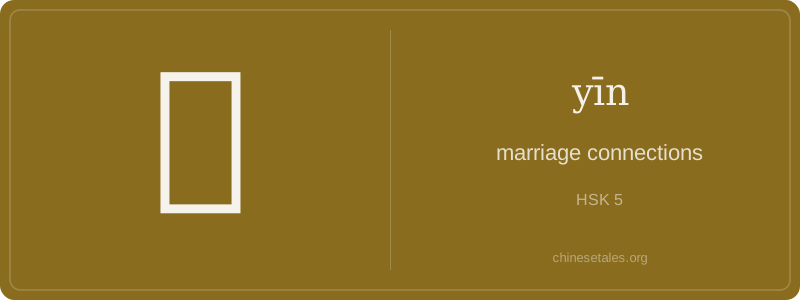
The earliest form of 姻 appears in bronze inscriptions as a compound: the radical 女 (nǚ, ‘woman’) on the left, paired with a simplified phonetic element that evolved into 因 (yīn) on the right. In oracle bone script, the right side resembled a kneeling figure enclosed in a square — suggesting ‘enclosure’ or ‘circumstance’. Over centuries, the figure morphed into 因, which itself means ‘reason’ or ‘cause’, reinforcing the idea that marriage creates new causal ties between families. The nine strokes settled into today’s clean structure: 女 (3 strokes) + 因 (6 strokes) — a perfect visual balance mirroring the symmetry of two families joining.
This character first appeared in classical texts like the Book of Rites (Lǐjì), where 姻 specifically denoted the wife’s family — the ‘marriage-side kin’ — distinguishing them from 婚 (the husband’s lineage). By the Han dynasty, 姻 expanded to mean any relationship formed through marriage, cementing its role in China’s kinship taxonomy. Interestingly, 因 (yīn) not only provides sound but also semantic depth: marriage isn’t accidental — it’s a ‘cause’ that generates lifelong obligations. The character’s elegance hides its weight: every stroke quietly enforces social continuity.
Think of 姻 (yīn) as Chinese ‘in-law DNA’ — not blood, but the intricate, sometimes awkward, always consequential web of relationships forged through marriage. Unlike English ‘marriage’ (a single event), 姻 is inherently relational and networked: it’s never used alone. You’ll never say *‘I have yīn’* — you say 姻亲 (yīn qīn, ‘marriage-related kin’) or 结姻 (jié yīn, ‘to form a marital alliance’). It carries quiet gravity, like ‘affinity’ in old English legal documents — formal, binding, and socially strategic.
Grammatically, 姻 almost always appears in compounds or set phrases; it rarely stands solo. Learners often mistakenly treat it like 婚 (hūn, ‘wedding/marriage’) and try to use it as a verb (*× 我姻了*), but 姻 is strictly nominal or adjectival. It functions like a silent prefix: 姻缘 (yīn yuán, ‘fated marital bond’) implies cosmic matchmaking, while 姻娅 (yīn yà, ‘relatives by marriage’) evokes extended family gatherings where everyone knows your cousin’s husband’s sister’s opinion on your career choices.
Culturally, 姻 reflects Confucian kinship logic: marriage isn’t just two people — it’s the merging of two lineages. That’s why 姻亲 can include your spouse’s grandparents, even if you’ve never met them. A common mistake? Over-translating 姻 as ‘marriage’ and missing its relational essence — e.g., confusing 姻亲 with 亲戚 (qīn qi, general ‘relatives’). The former is *only* marriage-derived ties; the latter includes blood relatives too. Also, note: 姻 has zero romantic connotation — it’s structural, not sentimental.