婆
Character Story & Explanation
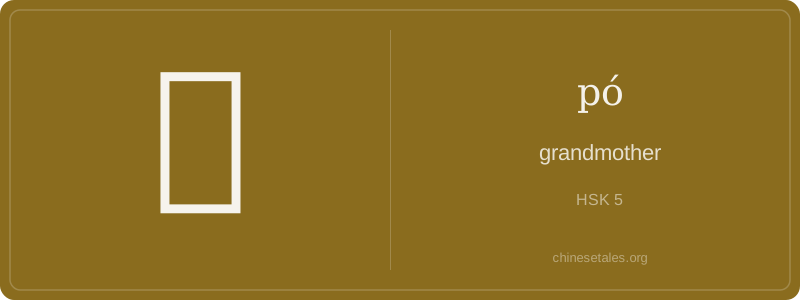
The earliest trace of 婆 appears in Han dynasty clerical script, not oracle bone — because it wasn’t originally pictographic at all. It emerged as a phono-semantic compound: the left side 女 clearly signals 'female', while the right side 波 was borrowed for sound (both 婆 and 波 were pronounced something like *ba* in Old Chinese). Over centuries, 波 simplified visually — its three dots (氵) and 波’s original ‘water + pī’ structure condensed into the streamlined 波 we see today, though the water radical disappeared entirely in 婆’s right component, leaving only the phonetic skeleton. The stroke count stabilized at 11 by the Tang dynasty: three for 女, eight for the right side — a balance of gender signifier and auditory anchor.
Meaning-wise, 婆 began in the Warring States period as a respectful term for elderly women, especially those in senior marital roles — hence its early link to mother-in-law (as in 婆母, later shortened to 婆婆). By the Tang, poets like Du Fu used 阿婆 tenderly in poems about aging village women, cementing its affectionate, earthy tone. Its visual simplicity — just 女 + a familiar sound — made it stick: easy to write, easy to say, rich in relational weight. Even today, the character feels less like a label and more like a nod — a quiet bow to the woman who holds the family’s emotional tide.
At its heart, 婆 (pó) is the warm, grounded presence of a maternal grandmother — but it’s far more than just a kinship term. Visually anchored by the 女 (nǚ, 'woman') radical on the left, its right side, 波 (bō, 'wave'), isn’t about water: it’s a *phonetic loan* that once approximated the ancient pronunciation and subtly evokes rhythm, repetition, and life’s gentle undulations — fitting for a matriarch who ‘rides the waves’ of family continuity. Unlike formal terms like 外婆 (wàipó, maternal grandmother) or 婆婆 (pópo, paternal grandmother), 婆 alone often appears in affectionate, poetic, or dialectal contexts — think classical poetry or southern speech where brevity carries intimacy.
Grammatically, 婆 rarely stands solo in modern standard Mandarin; it almost always pairs up — as in 婆婆 (pópo, 'grandmother' or 'mother-in-law'), 阿婆 (āpó, 'granny'), or 婆家 (pójiā, 'husband’s family'). Learners sometimes mistakenly use 婆 alone like 'grandma' in English ('I saw 婆 today'), but that sounds jarringly incomplete or even archaic — native speakers instinctively add a prefix or reduplication. It also appears in idioms like 婆妈 (pómā, 'fussy, overbearing'), showing how the grandmother archetype expanded metaphorically into personality traits.
Culturally, 婆 embodies quiet authority — not through command, but through endurance, care, and unspoken wisdom. A common pitfall? Confusing it with 婆婆 (pópo) and thinking they’re interchangeable: 婆婆 can mean *either* paternal grandmother *or* mother-in-law, depending entirely on context — a nuance that trips up even advanced learners. Also, note that while 婆 is HSK 5, its compounds appear much earlier in daily life — so mastering this character unlocks layers of familial, social, and literary meaning.