宣
Character Story & Explanation
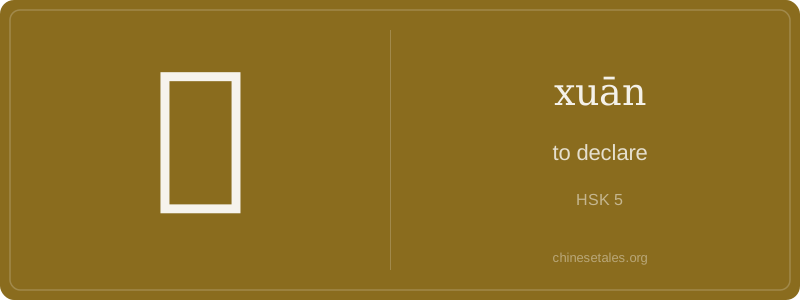
The earliest form of 宣 appears in Western Zhou bronze inscriptions as a roof (宀) sheltering a phonetic component resembling ‘亘’ (gèn, an ancient variant of 恒 meaning ‘enduring’), but more crucially, early forms show a stylized mouth (口) beneath the roof — visualizing speech emanating from within an authoritative space, like a hall of governance. Over time, the mouth evolved into the ‘and’ (厶) shape, and the lower part solidified into 日 (rì, ‘sun/day’) — not as a solar symbol, but as a phonetic loan (the ancient pronunciation of 宣 was close to *suen*, and 日 helped signal that sound). The nine strokes crystallized by the Han dynasty: 宀 (roof) + 厶 (a curl of breath) + 日 (phonetic anchor).
This architectural imagery stuck: 宣 literally means ‘speech under the roof’ — i.e., formal proclamation within an institution. In the *Zuo Zhuan*, we read of ministers 宣命 (xuān mìng) — ‘proclaiming the ruler’s command’ — always inside court halls. The character’s visual logic reinforces its semantic core: legitimacy requires both proper venue (the roof) and audible, sanctioned utterance (the mouth-derived 厶). Even today, when China 宣布 sovereignty over maritime zones, the character quietly invokes that millennia-old link between architecture, voice, and authority.
At its heart, 宣 isn’t just ‘to declare’ — it’s to declare *with authority*, *in public*, and *with resonance*. Think of a royal edict echoing under palace eaves, not a whisper in a chat group. It carries weight, formality, and institutional voice: governments 宣布 policy, courts 宣判 verdicts, and news outlets 宣传 values. Unlike casual verbs like 说 (shuō, 'to say') or 告诉 (gàosù, 'to tell'), 宣 implies official sanction, wide reach, and intentional influence — it’s declaration as social action.
Grammatically, 宣 almost never stands alone. It appears in tightly bound compounds: 宣布 (xuān bù, 'to announce'), 宣传 (xuān chuán, 'to propagate'), 宣誓 (xuān shì, 'to swear publicly'). You’ll rarely see it as a standalone verb in modern speech — saying *‘I 宣’* sounds like you’re quoting an ancient emperor. Learners often overuse it where 说 or 公布 would be natural, or mistakenly use it for personal opinions (e.g., *‘I 宣 my idea’* → wrong; use 提出 instead). Also note: 宣 is transitive and usually takes a noun phrase object — not a clause (so 宣布结果, not 宣布他来了).
Culturally, 宣 reveals how Chinese conceptualizes legitimacy: truth gains force not just through accuracy, but through *authorized articulation*. In imperial times, only the Son of Heaven could 宣 the Mandate of Heaven; today, state media 宣传 socialist core values — the character still marks discourse that shapes collective reality. A common mistake? Confusing it with similar-looking characters like 宜 or 宴 — which lack the ‘public roof + harmonious sound’ structure that makes 宣 uniquely resonant and official.