屋
Character Story & Explanation
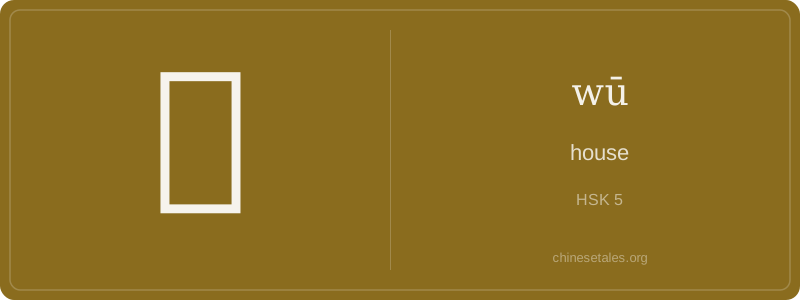
The earliest form of 屋 appears in oracle bone inscriptions as a stylized roof (宀) perched atop a person lying down (尸), suggesting a covered space where someone rests — literally, ‘a roof over a body’. Over time, the person evolved into the radical 尸 (shī), which originally meant ‘corpse’ but here functioned purely as a phonetic-semantic component indicating shelter and stillness. The top part solidified into 宀 (mián), the ‘roof’ radical, while the bottom simplified from a full figure to the three-stroke 尸 — not a dead body, but a seated or reclining human shape under cover. By the Han dynasty seal script, the nine strokes were standardized: two horizontal lines for roof beams, a vertical stroke down the center, and the six-stroke 尸 below — a perfect visual contract between protection and repose.
This ancient image of rest under shelter shaped its literary life: Confucius praised the ‘gentleman’s 屋’ — simple, dignified, unadorned — contrasting with ostentatious palaces. In Du Fu’s poetry, 屋 often appears broken by wind and rain (‘床头屋漏无干处’), making it a vessel for empathy and resilience. Even today, 屋 doesn’t just mean ‘building’ — it’s the silent witness to domestic life, carrying the weight of memory in every stroke. Its visual structure — roof above stillness — remains an unbroken thread from Shang dynasty bones to modern apartments.
Think of 屋 (wū) as the Chinese equivalent of the English word 'abode' — not just any building, but a place imbued with warmth, shelter, and quiet dignity. Unlike 房 (fáng), which is neutral and architectural (a 'room' or 'building'), 屋 carries poetic weight: it’s the roof over your head in a rainy poem, the humble cottage in a Tang dynasty verse, or the ancestral home in family stories. You’ll rarely hear it in real estate brochures ('luxury apartment') — that’s 房子 — but you’ll find it in phrases like 屋檐 (wū yán, 'eaves') or 屋内 (wū nèi, 'inside the house'), where intimacy and enclosure matter.
Grammatically, 屋 almost never stands alone as a noun in modern speech — you won’t say *‘I live in a wū’*; instead, it appears in compounds (屋子, 房屋, 屋顶) or fixed expressions. It’s also used metaphorically: 知识的殿堂 (zhī shi de diàn táng, 'hall of knowledge') contrasts with 知识的屋 (zhī shi de wū), which would sound oddly rustic and intimate — like calling a university library ‘my knowledge-cottage’. Learners often mistakenly substitute it for 房 in formal contexts, creating unintended folksiness.
Culturally, 屋 evokes stability and lineage — think of the idiom 青山不老,绿水长流,祖屋永存 (qīng shān bù lǎo, lǜ shuǐ cháng liú, zǔ wū yǒng cún): ‘Green mountains never age, clear waters flow forever — the ancestral house endures.’ Mistake it for a generic ‘house’, and you miss the reverence. Also, beware: 屋 is *never* used for commercial buildings (no ‘office wū’) — that’s 楼 or 大厦. Its quiet power lies precisely in what it *doesn’t* say: no commerce, no scale, just shelter with soul.