屉
Character Story & Explanation
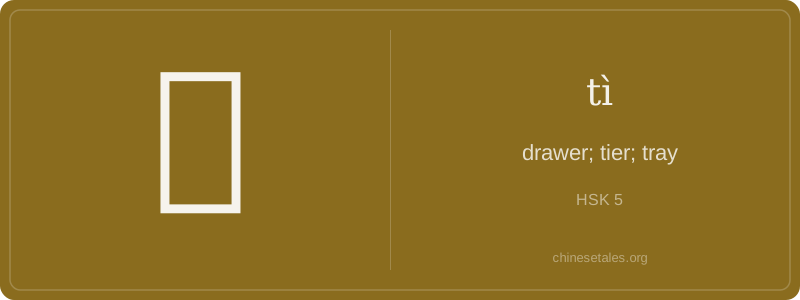
The earliest form of 屉 appears in late clerical script (around Han dynasty), evolving from a combination of 尸 (shī, 'corpse' radical—but here acting phonetically and semantically as a 'cover' or 'overhanging structure') and 世 (shì, 'generation', later simplified to 世 → 丗 → ). Originally, it depicted a low, covered platform or shelf—like a raised floor section under a bed or altar, meant to hold objects within easy reach yet concealed. The 尸 radical at the top suggests a 'roofed-over space', while the lower part evolved into the stylized 'world' shape, implying containment across time or layers—hence its later use for stacked tiers.
By the Song dynasty, 屉 solidified as 抽屉 (chōu tì), literally 'pull-out tier', reflecting the rise of joinery techniques that allowed sliding compartments in furniture. Classical texts like *The Craft of Gardens* (Yuanye) mention 屉 in descriptions of scholar’s desks—always paired with verbs like 抽 (chōu, 'pull') or 拉 (lā, 'drag'), emphasizing motion. Its visual structure—top cover (尸), middle 'layer' (the horizontal stroke), and base (the final stroke)—mirrors how a real drawer sits recessed, slides horizontally, and forms a self-contained unit. No wonder it became the go-to term for any tiered, accessible compartment—not just wood, but bamboo steamers, digital interfaces, and even metaphorical 'layers of meaning' in modern essays.
Imagine rummaging through an old wooden desk in a Beijing antique shop—your fingers brush past dusty ledgers, then *clunk*—you pull open a stubborn drawer that sticks halfway. That satisfying, slightly resistant slide? That’s 屉 (tì) in action: not just a neutral ‘box’, but a functional, movable compartment with weight, friction, and personality. In Chinese, 屉 almost always appears as part of a compound (like 抽屉 chōu tì, 'drawer') or in measure-word-like contexts (e.g., 一屉包子 yī tì bāozi, 'one tier of steamed buns'). It rarely stands alone—unlike English 'drawer', you’d never say *'This 屉 is broken'* without specifying the type.
Grammatically, 屉 behaves like a noun-classifier hybrid: it quantifies stacked, tray-like layers—especially in food contexts. You’ll hear it in kitchens (一屉馒头), workshops (工具屉 gōngjù tì, 'tool drawer'), and even computing ('desktop drawer' in some UI translations). Learners often overgeneralize it as a generic 'container'—but 屉 implies *sliding access*, *horizontal layering*, and *intentional design*. Saying 柜子 tì instead of 柜子 cùi zi (cabinet) will confuse native speakers instantly—it’s not a synonym for 'furniture'; it’s the *movable interior part*.
Culturally, 屉 carries quiet intimacy: your desk drawer holds secrets, receipts, love letters—or, in classic literature, hidden evidence (think *Dream of the Red Chamber*, where a character discovers a forbidden poem tucked in a lacquered 屉). Mistake it for 箱 (xiāng, 'box') or 盒 (hé, 'box/case'), and you lose that nuance of accessibility and layering. Also—don’t pronounce it tī or tǐ! The fourth tone (tì) is non-negotiable; mispronouncing it as tī sounds like the homophone 剔 (to pick out), which could hilariously imply 'I’m picking out my drawer.'