屿
Character Story & Explanation
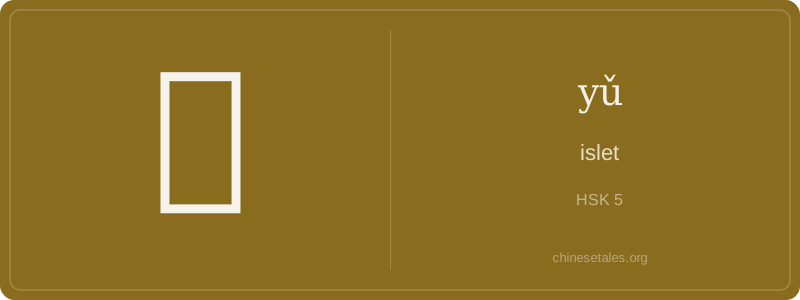
The earliest form of 屿 appears in seal script as 山 (a mountain peak) beside 宇 (a roofed enclosure), but that’s a red herring — the modern character evolved from a simpler pictographic fusion: 山 (radical, top) + 与 (yǔ, phonetic component below). Oracle bone inscriptions didn’t feature 屿 directly, but bronze script shows early variants with 山 + 余 or 山 + 予 — all chosen for sound, not meaning. By the Han dynasty, the standard form stabilized as 山 + 与: six clean strokes — three for 山 (the mountain cap), three for 与 (a stylized hand offering something — here, purely phonetic).
This is a classic ‘semantic-phonetic’ (xíngshēng) character: 山 tells you it’s landform-related; 与 tells you how to pronounce it (yǔ, nearly identical to 与’s reading). Unlike many characters where the phonetic hints at meaning (e.g., 河 ‘river’ has 可 for sound *and* water connotation), 与 contributes only sound — yet the pairing feels inevitable: a mountain *offering itself* to the sea. Classical texts like the Shuǐ Jīng Zhù (Commentary on the Water Classic) use 屿 to name real islets in rivers — always emphasizing verticality and separation, never flatness or fertility.
Imagine you’re sailing the South China Sea at dawn, mist curling over a cluster of green-capped rocks rising from turquoise water — not big enough to be islands, not small enough to vanish at high tide. That’s a yǔ: a *shān* (mountain) rising alone in water — an islet. In Chinese, 屿 isn’t just ‘small island’; it evokes solitude, resilience, and poetic seclusion — think of Tang poets retreating to ‘yǔ’ for meditation, not beach resorts. It’s almost always used in compound nouns or literary descriptions, rarely as a standalone noun in speech.
Grammatically, 屿 never stands alone like English ‘islet’. You’ll see it in compounds (e.g., gū yǔ — solitary islet) or poetic phrases like zhōng liú yǔ (islet in the river’s current), where it functions as a noun head with strong visual weight. Learners sometimes wrongly use it like ‘island’ (岛, dǎo) — but 屿 implies *small*, *rocky*, *mountainous*, and often *uninhabited*. Saying ‘我家在屿上’ sounds archaic or poetic — not ‘I live on an islet’, but ‘My home rests upon a lone, mist-wrapped peak rising from the sea’.
Culturally, 屿 appears in place names (Penghu’s Bái Yǔ, White Islet) and classical allusions to reclusion — Confucius praised those who ‘withdrew to a yǔ when virtue was obscured’. Modern learners overuse it in writing trying to sound ‘literary’, but native speakers reserve it for evocative contexts: travel essays, poetry, or geographic precision. Bonus tip: its tone (yǔ) matches 雨 (rain) — both evoke moisture, mist, and quiet isolation.