巨
Character Story & Explanation
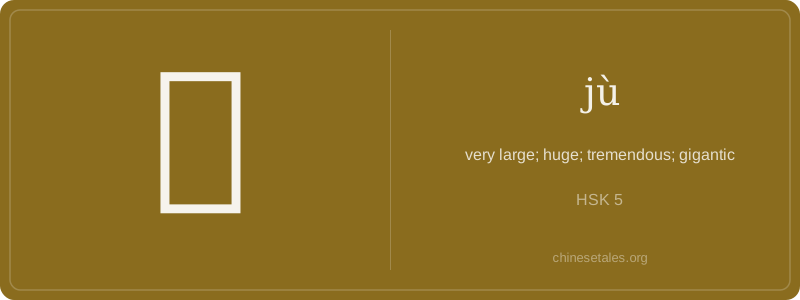
The earliest form of 巨 appears in oracle bone inscriptions as a stylized figure—a person standing upright with arms raised wide, enclosed within a square-like frame (the precursor to 匚). That frame wasn’t decorative; it represented a ritual boundary or measuring enclosure—implying ‘measured enormity’. Over centuries, the human figure simplified into two parallel horizontal strokes (一 一), while the enclosing 匚 hardened into its modern box-shape. By the Small Seal script, the four-stroke structure was fixed: 匚 + two horizontals + a vertical stroke anchoring the bottom—visually echoing containment and scale at once.
In classical texts like the *Zuo Zhuan*, 巨 described not just size but moral or political magnitude—e.g., 巨慝 (jù tè), ‘a heinous crime’, where ‘gigantic’ intensified ethical gravity. The character’s box-like radical 匚 (fāng) subtly reinforces this idea of bounded enormity—something vast yet defined, overwhelming yet structured. This tension between scale and order remains central: to call something 巨 is to acknowledge its power *and* place it within human reckoning.
At its heart, 巨 isn’t just about physical size—it’s about *impact*. In Chinese, 'huge' often implies significance, consequence, or even awe: a 巨大的挑战 (jù dà de tiǎozhàn) isn’t merely large—it’s formidable, career-defining. Unlike English ‘big’, which can be neutral or affectionate (‘a big hug’), 巨 carries weight—sometimes literal, always rhetorical. You’ll rarely say 巨的苹果 (‘gigantic apple’) unless it’s hyperbolic satire; instead, it modifies abstract nouns: 巨变 (massive change), 巨额 (enormous sum), 巨头 (industry titan).
Grammatically, 巨 is almost never used alone—it’s a prefix, always paired with 大 or embedded in compounds. Learners mistakenly try to use it like an adjective ('This box is 巨!'), but that’s ungrammatical. It only works as 巨大, 巨幅, 巨型, etc. Even in literary contexts, it functions adjectivally only when fused: 巨浪 (jù làng, ‘giant wave’) is one lexical unit—not ‘巨 + 浪’ as separable parts.
Culturally, 巨 echoes China’s long-standing reverence for scale as a marker of power and legitimacy—from the Great Wall to the Three Gorges Dam, ‘gigantic’ signals ambition, control, and historical gravity. Watch out: mixing up 巨 with 易 (yì, ‘easy’) or 臣 (chén, ‘minister’) is common—but those strokes matter. And no, 巨 is *not* related to ‘giant’ in English—it’s pure coincidence (and a fun linguistic mirage!).