厦
Character Story & Explanation
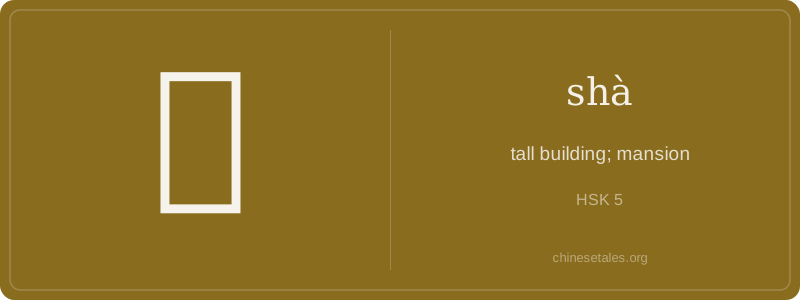
Oracle bone and bronze inscriptions show no direct precursor to 厦 — it’s a later creation, likely Warring States or early Han. The earliest form combines 厂 (a pictograph of a cliff overhang or sheltering rock face) with 下 (xià, 'down'), but crucially, the 'down' was originally written with a distinctive, sweeping horizontal stroke that later evolved into the current 口-like shape beneath 厂. Over centuries, the lower component stylized further: the dot and strokes fused into a compact, boxy unit — not a mouth (口), but a symbolic floor plan or enclosed courtyard under the sheltering 厂. This visual logic — 'shelter + enclosed space below' — made sense for large, grounded structures.
By the Tang dynasty, 厦 had crystallized as a literary term for spacious, elevated dwellings — especially those with wide eaves and open verandas, common in southern China’s humid climate. Du Fu wrote of 广厦 (guǎng shà, 'vast mansions') in his famous poem 'The Thatched Hut Destroyed by Autumn Winds', dreaming of shelters for all poor scholars — a line that cemented 厦’s association with benevolent, monumental architecture. Its form still echoes that dream: 厂 is the sweeping roofline; the lower part, though abstract, holds the human scale within — a reminder that even grandeur must shelter people.
At first glance, 厦 (shà) feels like a quiet aristocrat — it doesn’t shout like 楼 (lóu, 'building') or hustle like 房 (fáng, 'room'); instead, it evokes height, permanence, and quiet grandeur: a stately mansion, a scholar’s ancestral hall, or a colonial-era veranda in Xiamen. Unlike generic terms for buildings, 厦 carries subtle connotations of dignity, scale, and historical weight — you’d use it for a Qing-dynasty courtyard compound or the imposing architecture of Fujian tulou, not your apartment block.
Grammatically, 厦 is almost always a noun and rarely stands alone; it appears primarily in fixed compounds (like 厦门 or 广厦) or as part of literary or formal descriptions. Learners often mistakenly use it where 楼 or 大楼 would be natural — e.g., saying *这厦很高* instead of *这栋楼很高*. That’s like calling your condo ‘the manor’ in English: technically possible, but jarringly anachronistic. It also never takes measure words like 栋 or 座 — you say 一座大厦, not *一座厦*.
Culturally, 厦 reflects how Chinese architectural language encodes social meaning: the radical 厂 (cliff/overhang) hints at sheltered, expansive space — not just walls and roof, but protection, hierarchy, and communal presence. Interestingly, its modern usage is heavily place-anchored: 厦门 (Xiàmén) — literally ‘Xia Gate’ — gave the character renewed visibility, yet the city’s name ironically uses 厦 not for ‘mansion’ but as a phonetic loan (from ancient Min dialect). Many learners don’t realize this — they assume the character’s meaning directly explains the city’s name, when in fact it’s a beautiful historical accident.