废
Character Story & Explanation
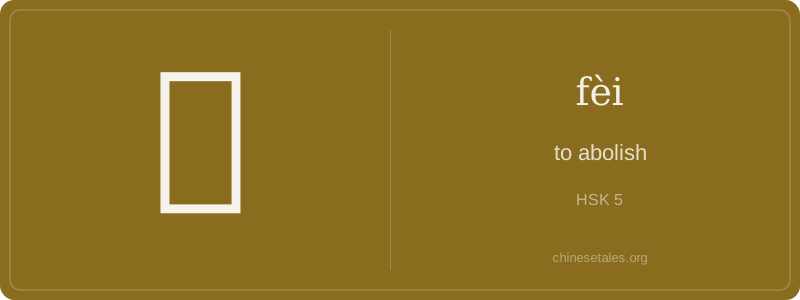
The earliest form of 废, found in bronze inscriptions (c. 1000 BCE), depicted a person kneeling beside a collapsed roof — the radical 广 (yǎn) representing a shelter or building, and the lower part (originally 癶 + 又) suggesting collapse or failure of support. Over centuries, the kneeling figure simplified into the current 犬-like component (actually a corrupted form of 癶), while 广 remained the roof-frame anchor. By the Han dynasty, the character stabilized into its modern 8-stroke shape: a broad ‘roof’ (广) sheltering chaos beneath — visually encoding the idea of structural breakdown.
This image of architectural collapse became metaphorical early on: in the Zuo Zhuan, 废 is used to describe deposing a ruler — ‘the state’s roof has fallen.’ By the Tang dynasty, it extended to laws and systems (e.g., 废律 ‘abolished statutes’), cementing its sense of top-down invalidation. Crucially, the character never meant ‘trash’ or ‘useless’ in classical usage — that meaning emerged much later, via semantic drift from ‘rendered nonfunctional’ to ‘no longer fit for purpose,’ eventually birthing slang like 废话 (fèihuà, ‘nonsense’).
Think of 废 (fèi) as Chinese bureaucracy’s ‘red X’ — not just ‘abolish,’ but the official, irreversible stamp that cancels something with finality, like a government edict voiding a law or a factory shuttering a production line. It carries weight and authority: you don’t ‘废’ your coffee cup; you ‘废’ a policy, a system, or a title. Unlike English ‘abolish,’ which feels historical (‘abolish slavery’), 废 is vibrantly modern — used daily in news headlines, legal documents, and even tech slang (e.g., 废号 ‘fèi hào’ = ‘abandoned game account’).
Grammatically, it’s almost always a transitive verb taking a concrete, institutional object — never people (you’d say 解雇 ‘jiěgù’ for ‘fire someone,’ not 废人). It often appears in passive constructions (被废) or compound verbs like 废除 (fèichú) and 废止 (fèizhǐ). Learners mistakenly use it where English uses ‘discard’ or ‘quit’ — but 废 implies systemic invalidation, not personal choice. Saying ‘我废了这个计划’ sounds bizarrely authoritarian; instead, say ‘我取消了这个计划.’
Culturally, 废 echoes China’s long tradition of centralized reform — from Qin dynasty standardization to modern regulatory overhauls. Interestingly, its negative connotation is so strong that in internet slang, 废柴 (fèichái, ‘waste wood’) ironically means ‘hopeless slacker,’ flipping bureaucratic gravity into self-deprecating humor — a nuance lost if you only memorize ‘abolish.’