强
Character Story & Explanation
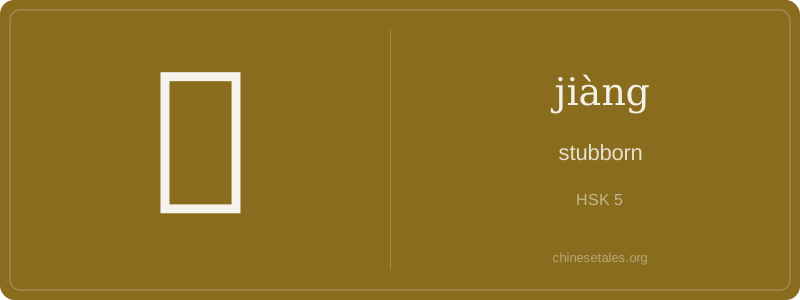
The earliest form of 强 appears in bronze inscriptions as two bows (弓) side-by-side, sometimes with a hand (又) or rope binding them — symbolizing tautness, tension, and resistance. Over time, the double-bow simplified into one bow radical (弓) on the left, while the right side evolved from 弓 + 口 + 工 (a stylized representation of tightly bound cords and a tool) into today’s 12-stroke structure. The bow wasn’t about archery per se — it was about the physical sensation of something drawn tight, vibrating with stored energy and refusal to yield.
This visceral image of taut resistance shaped its semantic path: from 'taut bowstring' → 'strength' (qiáng) → 'to force' (qiǎng) → and finally, in literary usage, 'unbending will' (jiàng). The Mencius (3rd c. BCE) uses 强 in the phrase '强为善' (qiǎng wéi shàn, 'to forcibly do good'), showing early tonal differentiation. By the Tang dynasty, poets like Du Fu used jiàng to describe unyielding integrity — not defiance for its own sake, but moral rigidity rooted in principle. Even today, when someone says '他强得很' (tā jiàng de hěn), they’re invoking that ancient bow-string tension — not loud anger, but quiet, immovable fiber.
At first glance, 强 (jiàng) feels like a linguistic curveball: it’s a 12-stroke character under the bow (弓) radical — yet here it means 'stubborn', not 'strong'! That’s because this pronunciation is a rare, preserved literary reading inherited from Middle Chinese, surviving almost exclusively in fixed expressions like 强嘴 (jiàng zuǐ, 'to talk back stubbornly') or 强项 (jiàng xiàng, 'a defiant strength'). Unlike qiáng ('strong') or qiǎng ('to force'), jiàng carries an unyielding, almost physical resistance — think of someone clenching their jaw and refusing to budge, not just mentally but bodily.
Grammatically, jiàng only appears as an adjective before nouns or in reduplicated forms like 强强 (jiàng jiàng), and crucially, it never takes degree adverbs (you can’t say *hěn jiàng* — that’s a classic learner error!). Instead, it pairs with verbs like 'to stick to' (坚持) or 'to argue' (争辩). You’ll hear it most often in classical allusions or in elder speech: '他脾气很强' is wrong; but '他性子强' (tā xìng·zi qiáng) uses qiáng — see how the tone changes everything? That’s why tone mastery isn’t optional here — it’s semantic armor.
Culturally, jiàng embodies a subtle tension in Chinese values: resilience is praised, but inflexibility is quietly cautioned. In the Analects, Confucius warns against '固执' (gùzhí, 'obstinacy') — and jiàng sits right on that fine line between admirable resolve and social friction. Learners often misread 强 in idioms like 强词夺理 (qiǎng cí duó lǐ, 'to argue fallaciously'), confusing the qiǎng tone with jiàng — a slip that turns 'forcing words' into 'stubborn words', derailing the whole idiom’s meaning.