弯
Character Story & Explanation
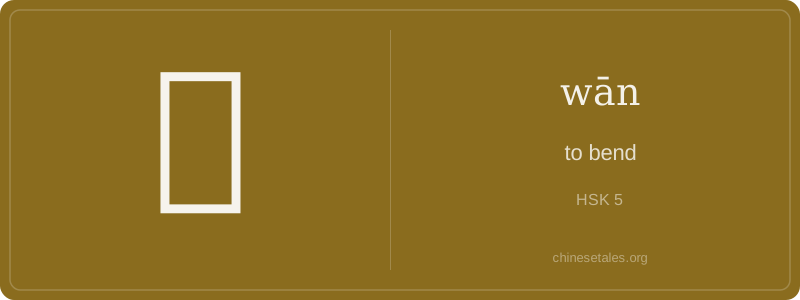
The earliest form of 弯 appears in bronze inscriptions as a stylized bow (弓) with a curved line sweeping across its middle — not just any curve, but the elegant, tension-filled arc of a drawn bowstring. That central stroke wasn’t random: it mimicked the taut, elastic curve created when pulling back the string. Over centuries, the bow radical (弓) remained firmly anchored on the left, while the right side evolved from a flowing curve into the modern 变 (biàn) component — not because it means 'change', but because its shape phonetically approximated the ancient pronunciation *wan*, and its looping strokes visually echoed bending motion. By the Han dynasty, the character stabilized into its current nine-stroke form: three clear sections — bow, bend, and completion.
This visual logic shaped its semantic journey. In the *Book of Odes* (Shījīng), 弯 described archery technique: 'The bow bends true before release.' Later, in Tang poetry, it softened into metaphor — Li Bai wrote of 'a crescent moon bending over the western hills', linking celestial curves to human posture and emotion. The character never lost its core idea of controlled, purposeful curvature: whether describing the Yangtze’s serpentine course, a dancer’s arched back, or the diplomatic 'bending' of policy without breaking principle.
At its heart, 弯 (wān) isn’t just ‘to bend’ — it’s the *graceful yielding* of something resilient under pressure: a willow branch in wind, a river carving its path, or even a person bowing with quiet dignity. Unlike stiff verbs like 折 (zhé, 'to break'), 弯 implies elasticity and intention — you can 弯腰 (bend at the waist), 弯路 (take a detour), or 弯曲 (describe physical curvature), but never 弯 a promise (that’s 违背 wéibèi). It’s deeply tactile: native speakers feel the gentle arc in their spine when saying 弯下腰.
Grammatically, 弯 is wonderfully flexible. As a verb, it takes direction complements naturally: 弯过来 (wān guòlái, 'bend over here'), 弯下去 (wān xiàqù, 'bend downward'). As an adjective, it modifies nouns directly: 弯路 (wān lù, 'detour'), 弯道 (wān dào, 'curve on a road or racetrack'). Watch out — learners often misplace it as a standalone command ('Bend!' → *弯!*), but native speakers almost always specify *what* bends: 弯腰!(bēnyāo! 'Bend your waist!') or 弯一下!(wān yíxià! 'Bend a little!').
Culturally, 弯 carries subtle connotations of humility and adaptability — virtues embedded in Confucian ideals of yielding without breaking. You’ll hear it in idioms like 曲意逢迎 (qūyì féngyíng, 'to bend one’s will to flatter'), where the 'bending' is moral, not physical. A classic mistake? Using 弯 for 'fold' (like paper) — that’s 折 (zhé). 弯 always preserves continuity; 折 risks rupture.