彼
Character Story & Explanation
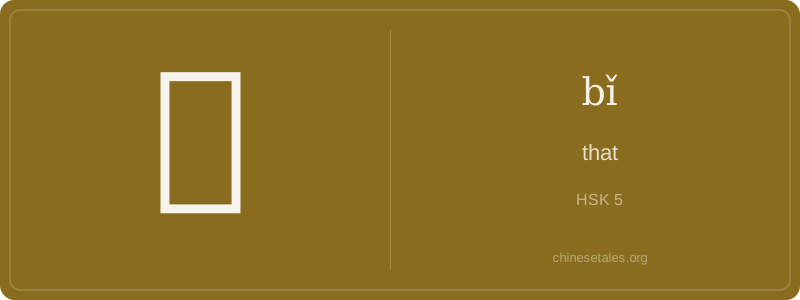
The earliest form of 彼 appears in bronze inscriptions around 1000 BCE — not as a pictograph, but as a phonetic-semantic compound. Its left side 彳 (chì) was the walking radical, hinting at movement or journey — fitting for a word denoting 'distance'. The right side, 比 (bǐ, 'to compare'), wasn’t just phonetic (both share the bǐ sound); it visually suggested two people standing side-by-side, emphasizing relational contrast. Over centuries, 比 simplified: its two 'people' ( + ) merged into the modern shape, while 彳 retained its three-stroke 'footsteps' structure — eight strokes total. By the Han dynasty, 彼 had fully stabilized into today’s elegant, asymmetrical form: light on the left, grounded on the right.
This visual logic shaped its meaning: 彼 didn’t just mean 'distant' — it meant 'the one *in relation to* this one'. In the Classic of Poetry, it appears in lines like '彼黍离离' ('That millet grows lush'), where 彼 isn’t arbitrary — it evokes nostalgic distance from a fallen capital. Later, Buddhist translators adopted 彼岸 (bǐ àn, 'that shore') for 'nirvana', contrasting earthly suffering (this shore) with liberation (that shore). Even today, the character’s structure whispers its core idea: take a step (彳), then compare (比) — and you’ve defined 'that'.
At first glance, 彼 (bǐ) seems like a simple 'that' — but it’s far more evocative than its English counterpart. In Chinese, 彼 doesn’t just point to physical distance; it carries a subtle psychological or moral remove — the 'that' of contrast, otherness, or even gentle irony. Think of it as the linguistic equivalent of raising an eyebrow: it signals you’re stepping back from something familiar to observe it with slight detachment or philosophical distance. You’ll rarely hear it in casual speech (where 那 nà dominates), but it thrives in essays, classical allusions, and rhetorical questions — like 彼时 (bǐ shí, 'at that time') implying a pivotal, almost mythic moment.
Grammatically, 彼 is a demonstrative pronoun — but unlike 那, it can’t stand alone as 'that one'; it must be followed by a noun or measure word (e.g., 彼岸 bǐ àn 'that shore', 彼人 bǐ rén 'that person'). It also appears in fixed literary phrases like 彼此 (bǐ cǐ, 'each other'), where its pairing with 此 ('this') creates a balanced, almost yin-yang duality. Learners often overuse it trying to sound formal — only to sound archaic or stilted. Remember: if you wouldn’t say 'verily, that man' in English, don’t use 彼 here.
Culturally, 彼 reveals how Chinese values precision in relational framing: 此 anchors us in our world; 彼 marks the boundary of the 'other' — whether another person, idea, or realm. This duality underpins Confucian ethics (self vs. others), Daoist cosmology (this side vs. the other shore of enlightenment), and modern political rhetoric (e.g., 彼国 'that country' subtly distancing the speaker). A common mistake? Using 彼 instead of 那 in spoken descriptions — like saying 彼个老师 when you mean 那个老师. Native speakers will notice instantly: it’s like quoting Shakespeare at a coffee run.