征
Character Story & Explanation
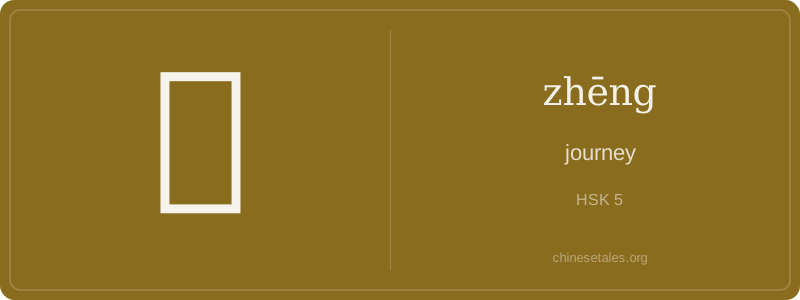
The earliest form of 征 appears in Western Zhou bronze inscriptions as a compound pictograph: left side 彳 (a walking path, suggesting movement), right side 正 (originally a foot stepping onto a target or territory — later stylized into ‘correct’). Together, they depicted ‘marching forward to claim or regulate land’. Over centuries, the right side simplified from 正’s full form (one foot + mouth/district marker) to its modern shape, while the left retained 彳 — emphasizing motion with intent. By the Qin bamboo slips, 征 had stabilized into its current 8-stroke structure: three strokes for 彳, five for the right component (一 丨 一 丶 丿).
This visual logic shaped its semantic evolution: from concrete military campaigns (e.g., ‘the Duke of Zhou 征 the Dongyi tribes’) in the *Book of Documents*, to administrative actions (‘requisitioning grain’ in Han statutes), then to abstract domains like opinion-gathering (Ming-Qing gazetteers say ‘zhēng yì’ — solicit public views). Unlike mere travel, 征 always implies sanctioned movement — authorized, consequential, and transformative. Confucius himself noted in the *Analects* (13.29) that true governance requires both virtue and the ability to ‘zhēng’ — not just rule, but actively engage, verify, and align reality with principle.
Imagine a lone traveler standing at the edge of a vast, mist-shrouded mountain pass — not on vacation, but on a mission: to survey new territory, gather intelligence, or deliver urgent imperial orders. That’s the vibe of 征 (zhēng): it’s not just any journey, but one with purpose, urgency, and authority. In classical Chinese, 征 almost always implied military expeditions or official missions — think ‘campaign’ or ‘dispatched journey’. Even today, it carries weight: you don’t ‘zhēng’ to the grocery store; you 征服 (conquer), 征询 (solicit opinions), or 征集 (collect systematically). It’s about directed movement toward a goal, often involving effort, legitimacy, and scope.
Grammatically, 征 rarely stands alone as a noun meaning ‘journey’ in modern spoken Mandarin — that’s a common HSK 5 trap! Learners hear ‘zhēng = journey’ and try *wǒ qù zhēng* (‘I go journey’), which sounds deeply unnatural. Instead, 征 appears almost exclusively in compound verbs: 征用 (to requisition), 征收 (to collect taxes), 征婚 (to seek a spouse via ad). It’s a high-register, formal, action-oriented character — never casual, never passive. Its object is usually abstract (opinions, land, consent) or institutional (taxes, labor, data).
Culturally, 征 echoes China’s long history of centralized administration and ritualized movement: from Zhou dynasty envoys bearing bronze tally tokens to modern census takers with digital tablets. Misusing it as a synonym for 旅行 (lǚxíng) or 走 (zǒu) risks sounding archaic or bureaucratically overblown. And watch the tone: zhēng (first tone) is easily confused with zhèng (fourth tone, as in 正), but mixing them turns ‘to solicit feedback’ (征询) into ‘to correctly ask’ — nonsense!