待
Character Story & Explanation
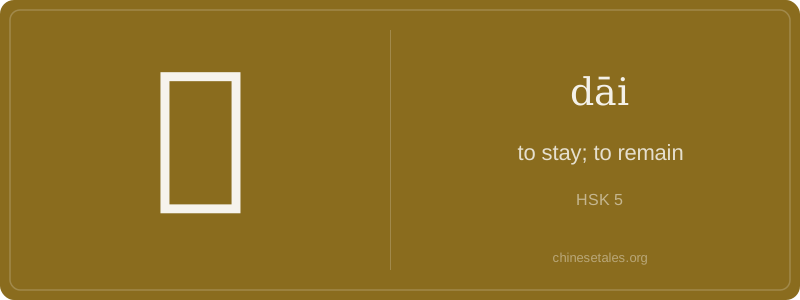
The earliest form of 待 appears in bronze inscriptions as a compound: left side 彳 (chì), a walking radical suggesting movement or path, and right side 寺 (sì), which originally depicted a hand holding a ceremonial vessel — later evolving to mean ‘temple’ or ‘official office.’ But crucially, 寺 also carried connotations of *staying in place to serve*, like an official stationed at a post. Over centuries, the right-hand component simplified from 寺 to 台 (tái), preserving the phonetic link while streamlining the shape — hence today’s 9-stroke 待: 彳 + 台, visually echoing ‘walking to a station and remaining there.’
This evolution mirrors its semantic journey: from classical texts like the Zuǒ Zhuàn, where 待 meant ‘to await with preparedness’ (implying readiness, not idleness), to Tang poetry where dāi emerged as the colloquial variant for ‘to stay put,’ shedding formality for intimacy. The character’s structure — a moving radical paired with a stable platform — perfectly captures its dual essence: arrival + stillness. You don’t just *be* somewhere; you *arrive there and settle in*, like setting down your bag and breathing deep.
Think of 待 (dāi) as the quiet, grounded cousin of ‘stay’ — not the dramatic ‘I’m never leaving!’ kind, but the calm, intentional ‘I’m right here, present, and not rushing off.’ It’s about lingering with purpose: waiting for a friend at a café, staying late to finish work, or even just pausing mid-sentence. Unlike the more formal or passive dài (as in dài yùn ‘to wait for an opportunity’), dāi is colloquial, embodied, and deeply everyday — you *dāi* in a place, not *dài* it.
Grammatically, dāi is almost always followed by a location (e.g., zài jiā lǐ dāi le sān tiān) and often pairs with aspect particles like le or guò. A classic learner trap? Using dài instead — saying ‘wǒ dài zài běijīng’ sounds like you’re ceremonially ‘awaiting Beijing’ like an imperial envoy! Also, dāi never takes an object: you can’t ‘dāi something’ — only ‘dāi somewhere’ or ‘dāi for someone’ (with zài + time/agent). Try ‘tā zài gōngsī dāi le liǎng nián’ — natural, warm, human.
Culturally, dāi carries subtle warmth and relational weight — staying late to chat with elders, dāi in a friend’s hometown during Spring Festival, or even ‘dāi zài yìdiǎn’ (lingering a bit longer) after dinner signals care and presence. Western learners often underuse it, defaulting to ‘zài’ or ‘zhù’, missing this gentle, time-anchored verb that makes speech feel authentically lived-in.