德
Character Story & Explanation
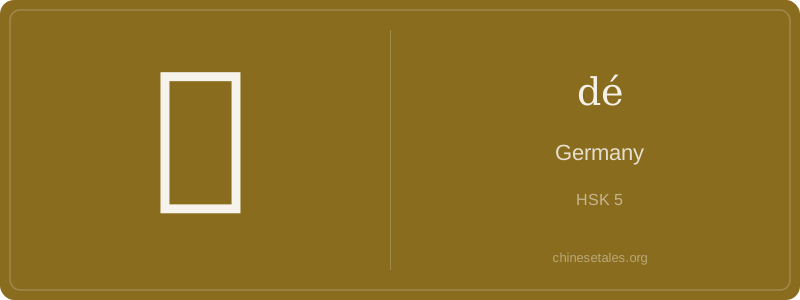
The earliest form of 德 appears on Shang dynasty oracle bones: a left-side 'footstep' radical (彳), a central 'eye' (目) — sometimes with a vertical line representing a straight gaze — and a right-side 'heart' (心). Later bronze inscriptions added 直 (zhí, 'straight') above the eye, emphasizing moral uprightness seen *and felt*. Over centuries, the eye morphed into 十 (shí) + 目, then simplified to the modern 直 component atop 心, while 彳 remained — evoking the idea of walking the upright path *with intention and inner awareness*.
This visual logic became philosophical reality: in the Book of Rites, 德 is defined as 'what one embodies when aligning heart, sight, and action'. Confucius declared, 'The virtue of the gentleman is like wind; the virtue of the small man is like grass — when the wind blows, the grass bends' (《论语》). The character didn’t just describe morality — it encoded a theory of ethical influence: visible conduct (彳), clear perception (直+目), and sincere motivation (心) — all fused into one ideograph.
Let’s clear up a big misconception right away: 德 (dé) does *not* mean 'Germany' — that’s a classic beginner trap! Its core meaning is 'virtue', 'moral character', or 'inner moral power' — a deeply Confucian concept referring to the quiet, radiant influence of ethical integrity. Think less 'country name' and more 'the kind of goodness that makes people naturally want to follow you'. In classical texts like the Dao De Jing, 德 is the lived manifestation of the Dao — not abstract ethics, but embodied excellence that resonates like gravity.
Grammatically, 德 functions as a noun (e.g., 道德 dé — 'morality'), appears in adjectival compounds (e.g., 德高望重 — 'of high virtue and great prestige'), and even forms verbs via derivation (e.g., 德化 — 'to transform through moral influence'). Learners often mistakenly use it as a standalone verb ('to be virtuous') — but it almost never stands alone as a predicate verb without a suffix or compound. You’d say 他很有德行 (tā hěn yǒu déxíng), not *他很德.
Culturally, 德 carries weight far beyond 'goodness': it implies efficacy — a ruler with true 德 attracts loyalty without force; a teacher with 德 inspires without scolding. A common error is over-translating it as 'virtue' and missing its active, gravitational nuance. Also, don’t confuse it with 得 (de/dé/děi) — same pinyin root, but totally different character and function!