彻
Character Story & Explanation
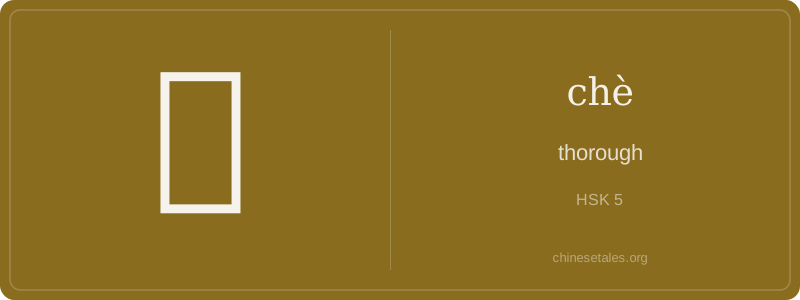
The earliest form of 彻 appears in Warring States bamboo slips, not oracle bones — and it’s a brilliant visual pun. It combines 彳 (chì), the 'step' radical suggesting movement forward, with 殹 (a variant of 砉, xū), which originally depicted a sharp, splitting sound — like wood cracking under pressure. Over time, 殹 simplified into 切 (qiè), but kept its sense of decisive cleavage. So the original character literally meant 'to step forward and split open' — imagine walking right up to a wall and breaking straight through it.
This physical image became philosophical: by Han dynasty texts like the Huainanzi, 彻 was used for 'penetrating insight' — as in 彻听 (chètīng), 'hearing through all barriers'. In Tang poetry, Du Fu wrote of 彻夜 (chèyè), 'all-night', evoking time pierced clean through darkness. The modern shape preserves this duality: the left 彳 shows purposeful advance, while the right 切 (with its knife-like 刂 component) delivers the final, clean cut — no residue, no hesitation.
Think of 彻 (chè) as the Chinese word for 'going all the way' — not just physically, but mentally, emotionally, and logically. It’s not mere 'completeness' like 完 (wán), nor simple 'finish' like 结束 (jiéshù); it’s about piercing through surface noise to reach bedrock truth or total implementation. You’ll hear it in phrases like 彻底 (chèdǐ, 'thoroughly, down to the root') — where 彻 adds that visceral sense of no layer left unturned.
Grammatically, 彻 rarely stands alone; it’s almost always paired — most often with 底 (dǐ) or 查 (chá). As an adverb, it modifies verbs: 他彻查了所有文件 (tā chè chá le suǒyǒu wénjiàn, 'He thoroughly investigated all documents'). As a verb stem in compounds like 彻悟 (chèwù), it signals a sudden, complete awakening — no half-realizations allowed! Learners often mistakenly use it like 'very' (e.g., *彻高兴) — but 彻 never modifies adjectives directly; that’s the job of 很 or 非常.
Culturally, 彻 carries weight from classical Daoist and Chan Buddhist texts, where 彻悟 means 'sudden, total enlightenment' — not gradual study, but shattering illusion in one flash. A common slip is confusing it with 切 (qiè, 'earnest'), especially in handwriting; both share the 彳 radical and similar stroke flow, but 切 has no 'thoroughness' connotation — it’s about sincerity or urgency. Remember: 彻 is about depth, not speed.