愁
Character Story & Explanation
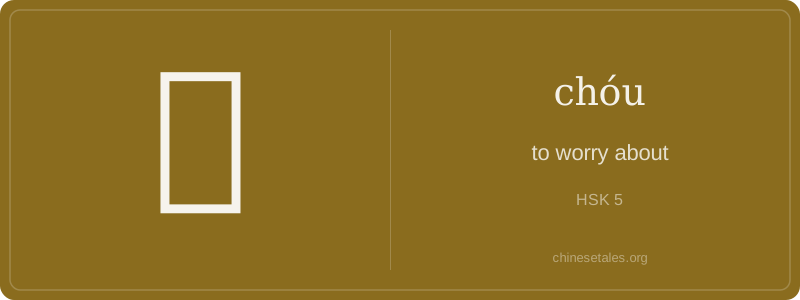
The earliest form of 愁 (in bronze inscriptions) was a compound pictograph: the top part resembled 秋 (qiū, ‘autumn’), with grain stalks and fire — symbolizing harvest time, when anxieties about winter provisions peaked. Below was 心 (xīn, ‘heart’), anchoring emotion. Over centuries, the top evolved: 秋 lost its fire element and simplified into 炎-like strokes (now written as 丷 + 文), while the bottom solidified as 心 — though in modern script, 心 appears as the lower component, visually ‘bearing’ the burden above. The 13 strokes map perfectly to this layered weight: 5 for the upper ‘anxiety structure’, 4 for the ‘heart’ base, and 4 for the connecting strokes that bind them.
This visual logic mirrors its semantic journey: from concrete seasonal anxiety (‘Will we starve?’) to abstract existential unease (‘What is my path?’). In the Book of Songs, 愁 appears in laments about exile; by the Tang dynasty, Li Bai used it to evoke cosmic loneliness — ‘I raise my cup to invite the moon, yet sorrow multiplies.’ The character doesn’t depict frantic action; it shows stillness under pressure — a heart holding autumn’s quiet crisis.
At its heart, 愁 isn’t just ‘worry’ — it’s the quiet, heavy, almost physical weight of unresolved concern. Think of a parent watching their child struggle silently, or a poet gazing at autumn clouds: 愁 carries emotional resonance, not panic or urgency (that’s 急 or 慌). It’s deeply introspective, often tied to fate, time, or unchangeable circumstances — hence why classical poetry uses it so frequently, like Du Fu’s line about ‘sorrow piled high as mountains.’
Grammatically, 愁 is versatile but picky: it’s primarily a verb meaning ‘to worry about [something specific]’, and *requires* an object (e.g., 愁考试, not just 愁). It can also be a noun (‘a worry’) or appear in reduplicated form (愁愁的) for gentle, lingering melancholy — but never as an adjective before a noun like ‘worried person’ (that’s 忧虑的 or 焦虑的). Learners often wrongly omit the object or overuse it like English ‘worry’ without context.
Culturally, 愁 reflects a Confucian-tinged acceptance: you don’t rage against hardship — you hold it quietly in your heart (the 心 radical), letting it shape your expression rather than your action. That’s why it appears in idioms like 愁眉苦脸 (frowning bitterly) — not as a call to fix things, but as an honest, dignified acknowledgment of life’s weight.