愧
Character Story & Explanation
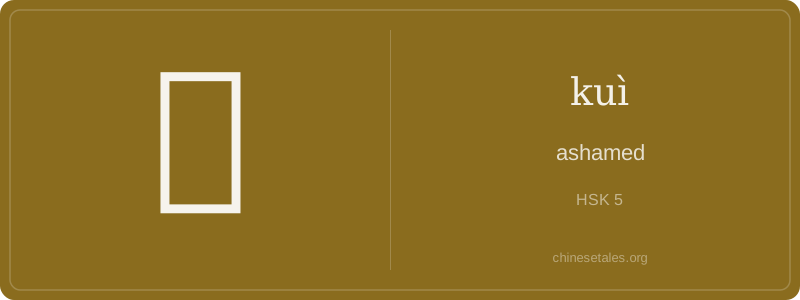
The earliest form of 愧 appears in bronze inscriptions as a combination of 心 (heart/mind) and 貴 (guì, 'precious, noble') — no pictograph of a person bowing, no visual shame. The original idea was subtle: ‘a heart weighed by what is noble’. Over time, 心 evolved into the left-side radical 忄 (the ‘heart-mind’ indicator), while 貴 simplified slightly — losing one stroke in the upper ‘crown’ part but keeping its core structure: two hands holding a ‘shell’ (ancient currency) beneath a ‘roof’, symbolizing valued status. By the Han dynasty, the modern 12-stroke form stabilized: 忄 (3 strokes) + 貴 (9 strokes) = 12, echoing the precision of moral accounting.
This visual logic shaped its meaning: 愧 isn’t about external judgment — it’s the internal reckoning when your actions fall short of your *own* sense of nobility or duty. Mencius wrote that ‘a gentleman feels 愧 before his parents if he fails in filial piety’ — not because they scolded him, but because his heart measured itself against an ideal. The character’s enduring power lies in that quiet symmetry: the heart (忄) confronting its own standard (貴). No gods, no judges — just conscience, calibrated against worth.
At its heart, 愧 (kuì) isn’t just ‘ashamed’ — it’s the quiet, heavy warmth behind your ears when you’ve let someone down *despite knowing better*. It carries moral weight, not just embarrassment: think failing a promise to your parents, not spilling coffee in public. Unlike generic shame (羞 xiū), 愧 implies self-judgment rooted in conscience — it’s what Confucius would call ‘the heart’s mirror catching its own flaw’.
Grammatically, 愧 is almost always used in compound forms or with verbs like 感到 (gǎn dào), 深感 (shēn gǎn), or as part of set phrases like 问心无愧. You’ll rarely see it alone as a predicate — saying *‘我愧’* sounds archaic or poetic. Instead, learners should master patterns like ‘愧对 + person/ideal’ (to feel unworthy before someone) or ‘自愧不如’ (to admit inferiority humbly). A common mistake? Using 愧 where 羞 or 尴尬 fits better — 愧 requires moral accountability, not just social discomfort.
Culturally, 愧 reflects the deep Confucian link between inner virtue (德 dé) and outward conduct. In classical texts, it appears in contexts of filial duty, scholarly integrity, or loyalty — never vanity. Modern usage retains that gravity: calling someone ‘无愧于心’ (wú kuì yú xīn) is high praise, meaning their conscience is clear. Learners often underestimate how emotionally loaded this character is — it’s not for light regret, but for moments that make you pause, breathe, and re-evaluate your values.