慌
Character Story & Explanation
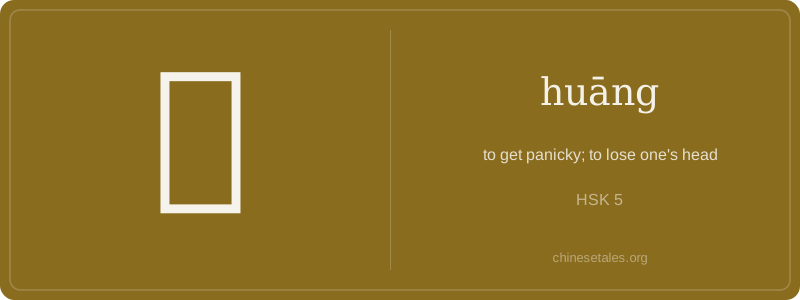
The earliest form of 慌 appears in seal script (c. 3rd century BCE), built from 忄 (the ‘heart-mind’ radical, indicating emotion) and 荒 (huāng, meaning ‘wild, desolate, uncultivated’). Visually, it was a heart beside a field overgrown with weeds — no plough, no order, no control. Over centuries, the right-hand side simplified from 荒’s full form (a grass radical atop a phonetic component) to today’s streamlined 荒: three horizontal strokes (like wind-blown grass), then a ‘death’ radical () morphed into the downward sweep, and finally the ‘child’ component (亡) flattened into the bottom stroke — all echoing entropy and loss of cultivation.
This visual metaphor became semantic reality: by the Han dynasty, 慌 appeared in texts like the *Shuōwén Jiězì* as ‘heart disturbed by wildness’, describing soldiers losing formation or scholars forgetting passages under pressure. In Tang poetry, it’s often paired with 魂 (soul) — 慌魂 — evoking a soul scattering like chaff. The character’s structure literally maps its meaning: a heart (忄) overwhelmed by wilderness (荒), making it one of Chinese writing’s most elegant psychological diagrams.
Imagine you’re sprinting through Beijing’s Forbidden City at dawn — late for your imperial examination — when you spot the palace gate slamming shut. Your heart jackhammers, your breath hitches, and your mind blanks: not fear of failure, but that dizzy, gut-lurching *loss of mental footing*. That’s 慌 (huāng) — not general fear like 怕 (pà), but the sudden, destabilizing panic where rational thought short-circuits. It’s visceral, physical, and deeply internal: you don’t ‘feel’ 慌; you *get* 慌, or *become* 慌.
Grammatically, 慌 is almost never used alone. It appears in reduplicative forms (慌慌张张), as a verb complement (急得直发慌), or in fixed compounds like 慌乱 or 慌神. Crucially, it’s rarely the main verb — you won’t say ‘I 慌’; you say ‘我慌了’ (I *lost it*) or ‘他慌了神’ (He lost his bearings). Learners often mistakenly treat it like an adjective (e.g., *huan* ‘panicky’), but it’s inherently dynamic — always signaling a *shift into* disarray, never a stable state.
Culturally, 慌 carries subtle moral weight: Confucian texts associate it with lack of self-cultivation (修养), implying that true composure (镇定) is learned, not innate. That’s why phrases like ‘别慌’ (Don’t lose it!) are so common — they’re not just advice, but gentle reminders of social expectation. A classic mistake? Using 慌 where 紧张 (jǐnzhāng, ‘nervous’) fits better: 紧张 suggests anticipation; 慌 signals collapse.