慎
Character Story & Explanation
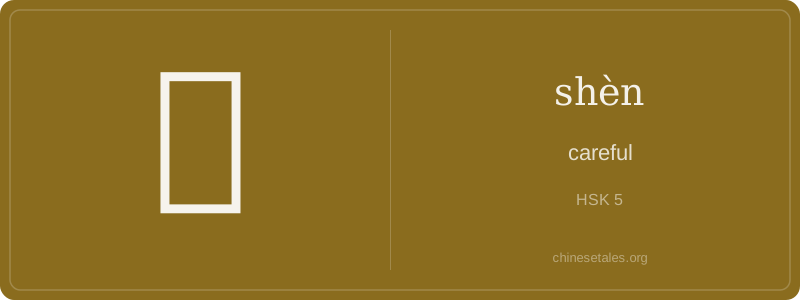
The earliest form of 慎 appears in bronze inscriptions as a combination of 心 (heart/mind) and 真 (zhēn, ‘true’, originally depicting a sacrificial vessel with upright lines suggesting authenticity). Over time, the left 心 radical simplified to the modern 忄 (‘heart-stroke’), while the right side evolved from 真’s complex oracle bone shape ( + 目 + 十) into today’s streamlined 真—though note: in 慎, the top of 真 is written as 真, not 眞 (the variant), and the lower part retains the ‘ten’ (十) and ‘eye’ (目) essence: watchfulness grounded in truthfulness.
This visual logic shaped its meaning: a mind (心) that sees clearly (目) and aligns with truth (真) — hence, ‘cautious deliberation’. By the Warring States period, Mencius praised sages who ‘慎其独’ (shèn qí dú)—‘are careful when alone’, highlighting inner integrity over outward performance. The character became central to Neo-Confucian self-scrutiny: Zhu Xi urged students to ‘慎思明辨’ (shèn sī míng biàn)—‘think carefully and discern clearly’—making 慎 less about avoiding mistakes and more about cultivating moral clarity through sustained attention.
At its heart, 慎 isn’t just ‘careful’ like a cautious driver—it’s a deeply moral kind of attentiveness: the quiet vigilance you bring before speaking, acting, or judging. In Chinese thought, carelessness isn’t merely inefficient; it’s ethically risky. That’s why 慎 appears in classical maxims like ‘慎言’ (shèn yán—‘speak with caution’) and ‘慎终追远’ (shèn zhōng zhuī yuǎn—‘treat the end with reverence and recall the distant ancestors’), where it signals ritual gravity, not just practical prudence.
Grammatically, 慎 is almost always an adjective or adverb—and rarely stands alone. You’ll see it as the first element in two-character compounds (慎思, 慎重) or paired with verbs (慎行, 慎选). Learners often mistakenly use it like English ‘careful’ before a noun (e.g., *慎学生*), but that’s ungrammatical—instead, say 慎重的学生 (a prudent student) or 学生要慎 (students must be careful). It’s also never used predicatively without support: you wouldn’t say ‘他很慎’—you’d say ‘他很慎重’ or ‘他做事很谨慎’.
Culturally, 慎 reflects Confucian self-cultivation: the idea that virtue grows from constant inner monitoring—not grand gestures, but micro-choices in speech, timing, and restraint. A common learner trap? Over-translating 慎 as ‘serious’ or ‘solemn’. While related, 慎 is about *intentional restraint*, not mood. Also, don’t confuse its tone: shèn (4th) is distinct from shēn (1st, e.g., 深)—mispronouncing it can turn ‘be careful’ into ‘deep’!