惭
Character Story & Explanation
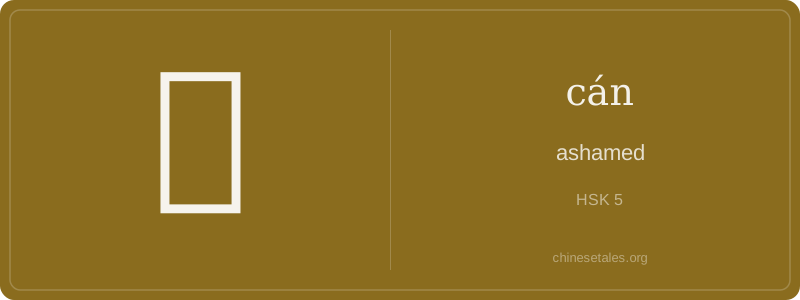
The earliest form of 惭 appears in Han dynasty clerical script, not oracle bones — it’s a relatively late arrival in the written record. Its structure reveals its logic: left side 忄 (xīn, ‘heart-mind’), right side 斬 (zhǎn, ‘to chop, behead’). But here’s the twist — 斬 isn’t acting as a phonetic alone. In ancient usage, 斬 carried connotations of ‘cutting away’ or ‘severing one’s former self’ — imagine the visceral shock of cutting off your own moral complacency. Over time, the top stroke of 斬 simplified from 刀-like to 丨+丿, and the bottom evolved from 車 (chariot, in early forms) to the modern 斤-like shape — all while preserving the core tension: heart + severance.
This visual metaphor crystallized in Buddhist-Chan texts by the Tang dynasty, where 惭 was paired with 愧 (kuì, ‘guilt toward others’) to form 惭愧 — the twin pillars of ethical awakening. As the Platform Sutra says: ‘惭者,内自不欺;愧者,外不欺人’ (‘Cán is not deceiving oneself inwardly; kuì is not deceiving others outwardly’). The character thus became less about punishment and more about self-honesty — the heart ‘chopping through’ illusion. Even today, when someone says 我很惭愧, they’re not just apologizing; they’re performing a quiet act of inner decapitation — shedding the false self to reveal integrity.
Think of 惭 (cán) as Chinese ‘crimson shame’ — not the hot flash of embarrassment, but the slow, quiet burn of moral self-awareness, like realizing you’ve betrayed a friend’s trust while sipping tea. It’s deeply internal, never performative: you don’t *show* cán; you *feel* it in your chest (hence the 忄 ‘heart-mind’ radical). Unlike English ‘ashamed’, which often pairs with ‘of’ + noun (‘ashamed of lying’), cán almost always appears in compound verbs or fixed phrases — rarely alone, and never as a predicate adjective like ‘I am ashamed’. You’ll see it in structures like 惭愧 (cánkuì) or 深感惭愧 (shēn gǎn cánkuì), where it’s bundled with feeling-verbs or intensifiers.
Grammatically, it’s a classic ‘bound morpheme’: it doesn’t stand solo in modern speech. Try saying *‘Wǒ cán’* — native speakers will blink and ask, ‘Cán what? How? With whom?’ It needs scaffolding: a verb (感到, 深感), a complement (惭愧, 惭赧), or a classical echo (e.g., ‘自惭形秽’). Learners often mistakenly use it like English ‘ashamed’ — dropping it into sentences as if it were an adjective — which sounds archaic or poetic, not conversational.
Culturally, cán carries Confucian gravity: it’s the inner tremor that precedes moral correction, the prerequisite for self-cultivation. Mistaking it for mere embarrassment misses its ethical weight — this isn’t about spilled soup, but about failing your role as son, student, or friend. And beware: its near-twin 惭 (same sound, same radical) is actually a different character entirely — no, wait, that’s the point: there *is* no other common character pronounced cán with 忄! That’s why learners misread 惨 (cǎn, ‘tragic’) or 残 (cán, ‘injured’) — but those lack the heart-radical’s moral pulse.