庆
Character Story & Explanation
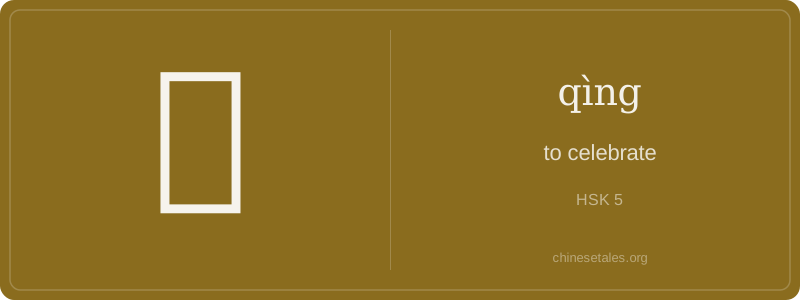
The earliest form of 庆 appears in bronze inscriptions of the Western Zhou (c. 1046–771 BCE), where it combined a phonetic element 夊 (suī, meaning ‘to walk slowly’) with a semantic component indicating ‘auspicious ceremony’. Over time, the top simplified into 广 (a ‘house’ radical symbolizing shelter, gathering, or official space), while the lower part evolved from 夊 + 禾 (grain) into the modern 大 + 儿 shape — visually suggesting ‘great people gathering under a roof to honor abundance’. By the Han dynasty, the character stabilized into its current six-stroke form: the broad 广 roof covering a joyful assembly — literally, ‘joy housed together’.
This visual logic shaped its meaning deeply: 庆 wasn’t just ‘happiness’, but *communal, ritually sanctioned joy*. In the Classic of Poetry (Shījīng), 庆 appears in lines like ‘以介景福’ (to invite great blessings), paired with ritual offerings. Its association with ‘good fortune granted by heaven’ persisted — hence 国庆 (guóqìng, National Day) isn’t merely ‘country party’, but ‘the nation’s auspicious occasion ordained by history and virtue’. Even today, when Chinese families hang red couplets reading 恭贺新禧, 庆 is the silent heartbeat beneath the characters — not noise, but resonance.
At its heart, 庆 (qìng) isn’t just ‘to celebrate’ — it’s the Chinese linguistic embodiment of *shared joy with reverence*. Unlike English ‘celebrate’, which can be casual or even ironic (‘Let’s celebrate surviving Monday!’), 庆 carries a quiet weight: it implies auspiciousness, communal recognition, and often formal or ritual significance — think national days, wedding banquets, or honoring elders. You’ll rarely hear it in slangy, offhand contexts; saying ‘庆一下!’ feels oddly ceremonial, like raising a jade cup instead of clinking beer bottles.
Grammatically, 庆 is almost always transitive and prefers formal or written register. It commonly appears as a verb (e.g., 庆祝, 庆贺) or in compound nouns (国庆, 喜庆). Learners often mistakenly use it alone as an intransitive verb like ‘we celebrate’ — but native speakers say 我们庆祝 (wǒmen qìngzhù) or 庆贺这个好消息 (qìnghè zhège hǎo xiāoxi), never *我们庆*. Also, note that while 庆 can stand alone in classical poetry or headlines (e.g., 庆丰收), modern spoken Mandarin strongly favors its compounds.
Culturally, 庆 reflects the Confucian ideal of harmony-in-ritual: celebration isn’t just personal happiness — it’s social alignment, gratitude to heaven/ancestors, and public affirmation of virtue or fortune. A common learner trap? Using 庆 where 恭喜 (gōngxǐ) fits better — you say 恭喜你毕业!(‘Congratulations on graduating!’), not *庆你毕业!* That’s because 恭喜 expresses interpersonal goodwill, while 庆 anchors joy in collective, consequential events — births, promotions, national milestones. Miss this nuance, and your sentence may sound like you’re declaring a state holiday for someone’s coffee order.