凭
Character Story & Explanation
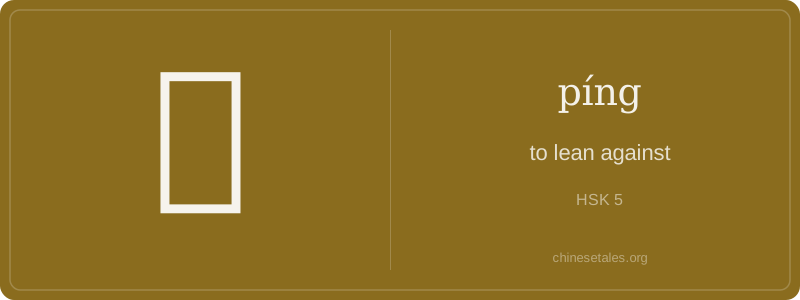
The earliest form of 凭 appears in bronze inscriptions as a combination of 几 (a low, sturdy table or stand) and 任 (a person bearing a load). Imagine a kneeling figure resting their weight on a simple wooden stand — the visual is intimate, grounded, and practical. Over time, the person component evolved into 任 (with its radical 亻 'person' and phonetic 壬), while 几 retained its shape as the radical. By the Han dynasty, the structure stabilized: the left side 任 suggests 'bearing responsibility', and the right side 几 remains the literal support — together, they crystallize the idea of 'relying on something stable to bear weight'.
This dual-layered origin explains why 凭 transcends mere physical leaning. In classical texts like the Zuo Zhuan, 凭 appears in phrases like 凭城而守 ('defend the city by relying on its walls'), where the wall isn’t just architecture — it’s strategic legitimacy. Later, in Tang poetry, it gained emotional resonance: poets wrote of 凭栏 (leaning on railings) to evoke contemplation and vulnerability — the railing becomes a metaphor for the thin line between resolve and sorrow. The character’s quiet geometry — only eight strokes, yet so balanced — mirrors its semantic role: minimal form, maximum functional weight.
At its heart, 凭 (píng) is about support — not just physical leaning, but the invisible scaffolding of trust, evidence, or authority that lets us act. Think of it as 'standing on' something solid: a document, a relationship, a reputation, or even sheer audacity. It’s never passive; it always implies active reliance — you *lean on* your credentials to enter a lab, *lean on* your friendship to ask a favor, or *lean on* logic to argue a point.
Grammatically, 凭 shines in two key patterns: first, as a preposition meaning 'by means of' or 'on the basis of' — always followed by a noun or noun phrase (e.g., 凭身份证 'by ID card'). Second, it appears in the elegant literary construction 凭 + [noun] + 就… ('just by…, [result follows]'), like 凭经验就能判断 ('Just by experience, one can judge'). Learners often mistakenly use it like English 'according to' — but 凭 demands concrete, tangible grounds, never vague opinions or hearsay.
Culturally, 凭 carries quiet gravity: it evokes Confucian ideals of earned legitimacy — you don’t just claim authority; you *demonstrate* the basis for it. A common mistake? Using 凭 when you mean 'because' (因为). That’s a logic error — 凭 is about justification, not causation. Also, watch tone: píng (second tone), never pīng or pǐng — mispronouncing it risks sounding like 'flat' (平) or 'to criticize' (评), both very different concepts.