戒
Character Story & Explanation
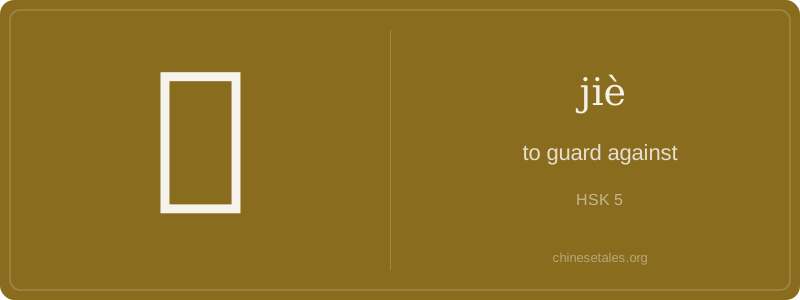
The earliest form of 戒 appears in bronze inscriptions as a hand holding a weapon (戈 gē, 'dagger-axe') pointed toward a person’s head — a vivid warning gesture: 'Stop! I’m armed and watching!' Over time, the 'person' simplified into the top component (廾 gǒng, 'cupped hands') and the weapon evolved into the radical 戈 at the bottom. By the seal script era, the structure stabilized: two hands (廾) above a spearhead (戈), visually shouting 'hands ready to act — danger ahead!' The modern character retains this urgent duality: upper part signals alertness and readiness, lower part signals threat or boundary.
This visual urgency shaped its semantic journey. In the Classic of Filial Piety (《孝经》), 戒 appears in the phrase '戒慎不睹,恐惧不闻' — 'Guard against what you cannot see; fear what you cannot hear' — highlighting its core sense of anticipatory vigilance. By Han dynasty texts, it had expanded to moral self-restraint, especially in Buddhist contexts where monks took 戒 (precepts) as vows of discipline. Crucially, the 戈 radical isn’t decorative — it roots the concept in real-world defense, making 戒 far more visceral than abstract synonyms like 防 (fáng, 'to prevent'). Its power lies in that ancient image: two hands gripping a weapon, not to strike, but to stand guard.
At its heart, 戒 (jiè) is about mental vigilance — not passive avoidance, but active, deliberate guarding against something dangerous or undesirable. Think of it as the Chinese equivalent of setting an internal alarm: ‘I’m on watch for this.’ It’s rarely used alone; instead, it anchors compound verbs like 戒烟 (jiè yān, 'to quit smoking') or 戒酒 (jiè jiǔ, 'to abstain from alcohol'), where it signals a conscious, often difficult, self-imposed restriction. Grammatically, it functions almost exclusively as a transitive verb meaning 'to guard against' or 'to abstain from' — never as a noun or adjective without modification (so no *‘a戒’ or *‘戒ly’). You’ll never say ‘I戒 smoking’ — it’s always 戒 + [noun/verb stem], e.g., 戒赌 (jiè dǔ, 'to quit gambling').
Learners often mistakenly treat 戒 like English ‘forbid’ (which implies external authority) — but 戒 is deeply personal and volitional. When a doctor says 你要戒糖 (nǐ yào jiè táng), it’s not a command; it’s an appeal to your self-discipline. Also, avoid confusing it with 禁 (jìn), which *does* carry legal or authoritative force (e.g., 禁止吸烟, 'smoking prohibited'). 戒 is the inner vow; 禁 is the posted sign.
Culturally, 戒 carries Buddhist and Confucian weight: the Ten Precepts (十戒) monks observe aren’t rules imposed by law, but vows undertaken to purify intention. That’s why 戒 feels solemn, even sacred — it’s less about breaking a rule and more about betraying your own commitment. A common error? Using 戒 for temporary caution (e.g., 'be careful crossing the street') — that’s 小心 (xiǎo xīn) or 当心 (dāng xīn), not 戒. Reserve 戒 for sustained, principled abstinence.