战
Character Story & Explanation
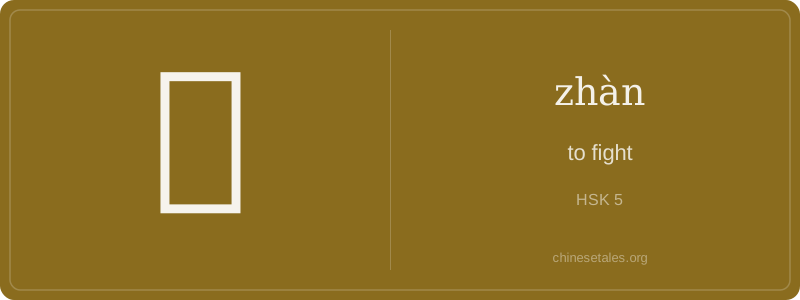
Trace back to Shang dynasty oracle bones (~1200 BCE), and 战 began as a vivid pictograph: a warrior holding a halberd-like weapon (戈, gē — the radical we still see today) while standing beside a ‘cutting’ or ‘chopping’ element (卩, later stylized into 占). In bronze inscriptions, the ‘weapon’ was prominent and angular, emphasizing readiness and aggression. Over centuries, the ‘person’ and ‘action’ components condensed: 占 (originally depicting a kneeling figure receiving divination — later repurposed phonetically) fused with 戈, streamlining into today’s elegant 9-stroke form — the weapon remains unmistakable at the right, the left side now purely phonetic (zhàn sound).
This evolution mirrors meaning expansion: from literal armed combat (as in the Spring and Autumn Annals, where 战 describes state-vs-state warfare) to metaphorical struggle by the Han dynasty. Mencius wrote of 战于野 (‘fighting in the wilds’) to critique rulers who waged war without moral justification — cementing 战 as morally charged, not neutral. Its visual duality — weapon + phonetic — became a template for hundreds of characters: the radical signals domain (here: conflict), the phonetic hints pronunciation. Even today, seeing 戈 instantly tells you this character belongs to the world of defense, offense, or confrontation — no translation needed.
At its heart, 战 (zhàn) isn’t just ‘to fight’ — it’s the visceral, strategic, often high-stakes *act* of engaging in conflict: whether on a battlefield, in a debate, or even against time. Unlike generic verbs like 打 (dǎ, ‘to hit’), 战 carries weight and intention — you don’t ‘fight’ a cold with 战; you ‘battle’ a deadline (战时间) or ‘wage war’ on corruption (反腐之战). It’s inherently dynamic and often paired with nouns (e.g., 战斗, 战役, 战略) to form rich, layered concepts.
Grammatically, 战 is most commonly used as a verb in compound structures or as the core of noun-verb blends. You’ll rarely see it alone in modern speech — instead, it appears in verb-object compounds like 战胜 (zhànshèng, ‘to defeat’) or subject-predicate phrases like 他战无不胜 (tā zhàn wú bù shèng, ‘He wins every battle’). Learners often mistakenly use it as a standalone transitive verb like ‘I fight him’ — but that’s unnatural; native speakers say 我跟他打了一架 or 我击败了他. 战 needs context — a cause, a scale, or a metaphorical arena.
Culturally, 战 evokes classical military thought (Sun Tzu’s Art of War opens with 兵者,诡道也 — warfare is deception), yet it’s also deeply embedded in modern life: 战绩 (‘battle record’ = achievements), 战友 (‘battle comrade’ = lifelong friend forged in shared struggle), even 战痘 (‘acne battle’ — playful but widely understood). A common pitfall? Overusing it for minor conflicts — your coffee spilling isn’t a 战; it’s an accident. Reserve 战 for moments where stakes, effort, and strategy converge.