舍
Character Story & Explanation
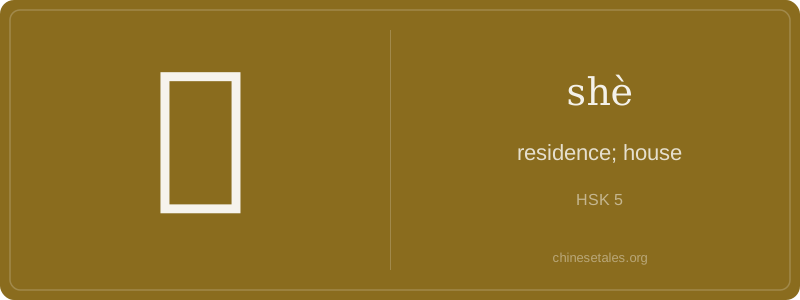
The earliest form of 舍 appears in bronze inscriptions as a pictograph showing a roof (宀) over a tongue (舌) — yes, literally a 'roof + tongue'. Scholars now believe this wasn’t arbitrary: in ancient China, the 'tongue' represented speech, authority, and ritual utterance — and a residence wasn’t just shelter, but the locus where family rites were performed, ancestors invoked, and lineage declared. Over time, the roof simplified into 宀, and the tongue evolved into the modern 舌 radical (though its shape softened from a clear tongue outline to today’s stylized form). By the Han dynasty, the character had stabilized into its current eight-stroke structure: two dots (丶丶) atop 宀, then 舌 below — totaling eight strokes, mirroring the 'eight corners' of a traditional courtyard home.
This visual logic deepened its meaning: 舍 wasn’t just four walls — it was where identity was spoken into being. In the Book of Rites, 'residence' (shè) defined social rank: nobles occupied 大舍 (dàshè), commoners lived in 小舍 (xiǎoshè). Even in Du Fu’s poetry, 舍 conveys fragility and transience — 'my thatched hut blown away' (茅屋为秋风所破歌) uses 茅舍 (máoshè) to evoke humble yet deeply human shelter. The tongue beneath the roof reminds us: a house becomes a home only when words — vows, lullabies, ancestral prayers — are spoken beneath it.
Think of 舍 (shè) as the Chinese equivalent of 'manor' or 'residence' in British English — not just any house, but a place with history, status, and social weight. It evokes walled compounds, ancestral halls, or quiet courtyards where elders hold court — never a modern apartment or dorm room. You’ll find it in formal, literary, or historical contexts: 'guesthouse' (旅舍 lǚshè), 'monastery quarters' (僧舍 sēngshè), or even 'the emperor’s residence' in classical texts. Unlike the neutral 家 (jiā) or colloquial 房子 (fángzi), 舍 carries quiet dignity — and a faint whiff of antiquity.
Grammatically, 舍 almost never stands alone as a noun in speech; it’s nearly always bound in compounds. Learners often mistakenly say *'wǒ de shè'* ('my residence') — which sounds like quoting a Tang dynasty poet at a tea ceremony. Instead, use it in set phrases: 旅舍 (inn), 校舍 (school building), or 舍弟 (humble term for 'my younger brother'). Note: when pronounced shě, it means 'to abandon' — a completely different character etymologically (same spelling, different origin), like English 'lead' (metal) vs. 'lead' (to guide). Don’t mix them up!
Culturally, 舍 appears in idioms like 舍生取义 (shěshēng qǔyì — 'give up life to uphold righteousness'), where the shě pronunciation dominates — but that’s a homophone, not the same character. The residence sense (shè) is exclusively written as 舍 in compounds, never used verbally. A classic mistake? Writing 舍 when you mean 宿 (sù, 'to lodge') — they sound similar, but 宿 is the verb; 舍 is the noun container for that action.