挣
Character Story & Explanation
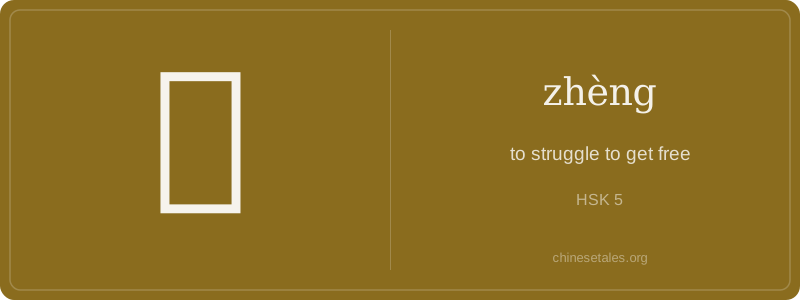
The earliest form of 挣 appears in Han dynasty clerical script as 扌 (hand radical) + 争 (zhēng, 'to contend'). There’s no oracle bone version — it’s a later semantic-phonetic compound. Visually, it’s elegant efficiency: the left side 扌 signals hand-related action (grabbing, pulling, twisting), while the right side 争 — originally depicting two hands tugging over a thing — provides both sound (zhēng → zhèng, tone shift common in derivations) and core meaning: conflict over control. Stroke by stroke, it evolved from rounded clerical forms to today’s crisp, angular shape: three strokes for the hand radical (lift, press, hook), then six for 争 — each line feeling like a taut rope under strain.
This visual duality — hand + contest — perfectly anchors its meaning. In early medieval texts, 挣 described physical escape (e.g., '挣断绳索', 'wrested apart the ropes'), but by the Ming dynasty, it expanded metaphorically: Zhu Yu’s *Pingzhou Table Talks* notes sailors ‘挣风’ (zhèng fēng, 'struggle against the wind') — not just fighting weather, but asserting human will. The character’s endurance lies in that fusion: every time you write those nine strokes, you’re tracing the ancient image of two forces locked in motion — one hand pushing, one hand resisting, neither yielding.
At its heart, 挣 (zhèng) is about resistance — not passive waiting, but active, muscular effort to break free: from ropes, expectations, poverty, or even gravity itself. Think of a fish thrashing in a net, or a child twisting out of a tight hug. The character pulses with physical tension and urgency; it’s never abstract or gentle. You’ll almost always see it paired with verbs of motion or constraint — like 挣脱 (zhèngtuō, 'to break free from'), 挣扎 (zhēngzhá, 'to struggle'), or 挣开 (zhèngkāi, 'to force open'). Notice the tone shift: zhèng is the fourth tone — sharp and decisive — matching the character’s abrupt, effortful energy.
Grammatically, 挣 rarely stands alone. It’s almost always the first syllable in disyllabic verbs, and crucially, it *requires* an object or complement indicating *what* is being escaped or overcome. Saying just '他挣' is incomplete — like saying 'he wrestled' without saying what he wrestled. Learners often mistakenly use it like English 'struggle' (intransitive), but in Chinese, 挣 is fundamentally transitive or part of a compound. Also beware: it’s easily confused with 静 (jìng, 'quiet') or 症 (zhèng, 'symptom') — same pinyin, wildly different meaning and writing.
Culturally, 挣 carries quiet moral weight: 挣脱命运 ('break free from fate') appears in modern novels criticizing rigid social structures, while 挣钱 ('earn money') reflects China’s rapid economic transformation — money isn’t inherited, it’s *wrested* through grit. Interestingly, in classical texts, 挣 was rare; its rise mirrors 20th-century themes of individual agency. A common error? Using it for 'earn' without context — 挣钱 works, but *just* 挣 for 'earn' sounds archaic or poetic, not conversational.