采
Character Story & Explanation
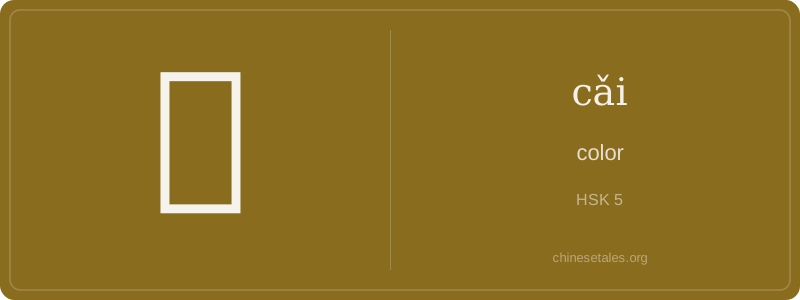
The earliest form of 采 appears in bronze inscriptions as a vivid pictograph: a hand (爫, the claw radical on top) reaching down to pluck fruit or leaves from a tree (木). Over time, the tree simplified into the 木 component at the bottom, while the hand evolved into the distinctive 釆 (biàn) radical — originally depicting a deer’s antlers, symbolizing sharp, discerning vision (since deer scan their surroundings with alert precision). By the seal script era, the hand + tree composition had stabilized, and the 釆 radical was reanalyzed as 'discernment through sight', reinforcing the idea of selective gathering.
This visual logic shaped its semantic journey: from literal 'plucking fruit' (Shuōwén Jiězì, 2nd c. CE) → 'selecting/gathering' (e.g., 采诗, 'collecting folk songs' for royal archives) → 'perceiving/extracting essence' (e.g., 采色, 'perceiving color tones' in Tang painting theory). In the Book of Songs, '采采卷耳' (Cǎi cǎi juǎn’ěr) — 'Gathering, gathering dogwood' — uses reduplicated 采 to evoke rhythmic, intentional collection, linking labor, aesthetics, and moral cultivation in one stroke.
Think of 采 (cǎi) as the Chinese equivalent of 'palette' — not just a container for colors, but the *act* of selecting, gathering, and interpreting visual richness. Its core meaning isn’t static 'color' like a paint swatch; it’s the *process* of perceiving and extracting hue, tone, and atmosphere — hence its use in words like 采访 (cǎifǎng, 'to interview': literally 'gathering speech') and 采纳 (cǎinà, 'to adopt [a suggestion]': 'gathering and accepting').
Grammatically, 采 is almost never used alone as a noun meaning 'color' — that’s a classic HSK 5 trap! Learners say *'zhè ge yán sè hěn cǎi'* (❌), but native speakers say *'zhè ge yán sè hěn yǒu cǎi'* (✅) — because 采 here functions as a noun only in fixed compounds or abstract contexts (e.g., 风采 fēngcǎi, 'personal charisma'). It’s most active as the first character in verbs: 采茶 (cǎi chá, 'to pick tea leaves'), 采矿 (cǎi kuàng, 'to mine'), 采光 (cǎi guāng, 'to admit light').
Culturally, 采 carries an elegant, almost scholarly weight — it evokes classical poetry where 'gathering fragrance' (采芳 cǎi fāng) symbolized seeking virtue. Modern learners often misread it as 'cai' (like 才 or 财) and miss its distinctive 釆 radical (which looks like a deer’s antlers but actually means 'to distinguish by sight'). Remember: when you see 采, think 'curator of color' — not 'crayon'.