握
Character Story & Explanation
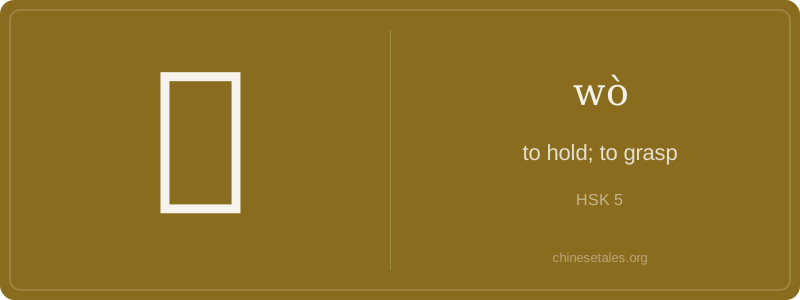
The earliest form of 握 appears in bronze inscriptions as a hand (扌 radical) grasping a simplified pictograph resembling a bent rod or staff — likely representing something long and rigid to be firmly gripped, such as a ritual scepter or weapon. In oracle bone script, the hand component was more pictorial (a clear outline of fingers and palm), and the right side evolved from a glyph depicting a bent object being enclosed by the hand’s curve. Over centuries, the right-hand component standardized into 3+4 strokes (爫 + 冖 + 又), losing its literal shape but retaining the idea of enclosure and control — eventually crystallizing into the modern ‘屋’-like top-right structure.
This evolution mirrors its semantic journey: from concrete, ritualized grasping (e.g., holding ancestral tablets in Zhou dynasty rites) to broader intentional control — in classical texts like the *Zuo Zhuan*, 握 is used for seizing authority (握权), and in poetry, for clutching memories or emotions (握别, ‘gripping farewell’). The visual logic remains intact: the left 扌 shouts ‘hand action!’ while the right side, though abstracted, still suggests enclosure, containment, and decisive grip — a perfect marriage of form and function across 3,000 years.
At its heart, 握 (wò) is about intimate, deliberate physical contact — not just holding something, but gripping it with purpose and presence. Think handshake, not casual palm-up cupping; think clutching a fragile object or gripping a sword hilt before battle. It implies agency, control, and often emotional weight: you 握手 (shake hands), 握住机会 (seize an opportunity), or 握紧拳头 (clench your fist) — all actions where intention meets touch.
Grammatically, 握 is almost always transitive and requires a direct object — you *must* 握 something. It rarely stands alone as a verb in speech without context. Learners often mistakenly use it like English 'hold' in passive constructions ('the book is held'), but 握 doesn’t work passively like that — instead, use 被握着 or more naturally, 拿着/拿着. Also, 握 is rarely used for abstract possession (‘I hold an opinion’ → 我认为, not 我握有观点 — though 握有 *does* exist in formal written Chinese meaning ‘to possess’, e.g., 握有实权).
Culturally, 握 carries subtle social gravity: 握手 is the standard greeting, but 握手时力度, duration, and eye contact convey respect, confidence, or even dominance. Overly tight 握 can feel aggressive; too limp feels dismissive. And watch out — 握 is easily confused with 托 (to support from below) or 抓 (to grab suddenly). The key? 握 is firm, controlled, and sustained — like two hands meeting deliberately, not snatching or lifting.