挥
Character Story & Explanation
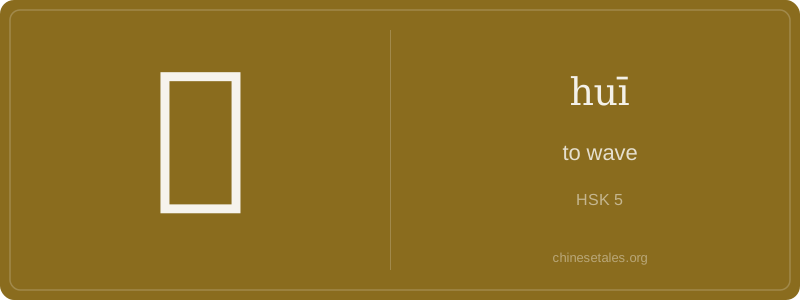
The earliest form of 挥 appears in bronze inscriptions as a hand (扌) gripping a curved, whip-like object—possibly a riding crop or ceremonial rod—suggesting controlled motion rather than random flailing. Over centuries, the right side evolved from a pictograph of a bent staff (軍, jūn, ‘army’) into the modern 辛 (xīn, ‘bitter’/‘toil’), though this was purely phonetic borrowing: 辛 provided the ‘huī’ sound, while 扌 held the meaning. By the Han dynasty, the character stabilized at nine strokes: three for the hand radical (扌), then six for 辛—two horizontal lines, a vertical stroke, and three dots (or a ‘lid’ shape), visually echoing the sharp, crisp motion it denotes.
This evolution reflects a classic Chinese linguistic strategy: fuse meaning (hand action) with sound (辛), even when the sound component has no semantic connection. Classical texts like the Shuō Wén Jiě Zì (121 CE) define 挥 as ‘to shake off’ or ‘to dispel’—a sense preserved in 挥散 (huī sàn, ‘to disperse’). Later, poets like Li Bai used 挥毫 to capture artistic abandon: ‘He seized the brush and huī háo, ink flying like wind’—turning a simple gesture into a symbol of creative sovereignty.
At its heart, 挥 (huī) isn’t just about waving your hand—it’s about *directed energy*: a decisive, often expressive motion that sends something outward—be it a hand, a sword, ink, or even authority. Unlike English ‘wave,’ which can be casual or passive (‘wave hello’), 挥 carries intention and agency: you 挥手 (wāi shǒu) to dismiss, 挥刀 (huī dāo) to strike, or 挥毫 (huī háo) to paint with bold, unrestrained brushstrokes. It implies control, flair, and sometimes even recklessness—think 挥霍 (huī huò), ‘to squander,’ where wealth is ‘waved away’ like loose change.
Grammatically, 挥 is almost always transitive and requires an object (or implied object), especially in formal or literary contexts. You don’t just ‘huī’—you 挥手, 挥剑, 挥泪 (huī lèi, ‘shed tears’—literally ‘wave tears’). Learners often mistakenly use it intransitively (e.g., *‘He huīs’*), but native speakers say ‘他挥了挥手’ (tā huī le huī shǒu)—repeating the noun for rhythm and clarity. This reduplication isn’t optional flourish; it’s grammatical grounding.
Culturally, 挥 reveals how Chinese values link physical gesture to moral posture: 挥洒自如 (huī sǎ zì rú, ‘to wield freely and gracefully’) describes not just calligraphy, but any mastery—of speech, leadership, or art—that feels effortless yet authoritative. A common error? Confusing 挥 with similar-sounding characters like 灰 (huī, ‘ash’) or 归 (guī, ‘to return’)—but more dangerously, mixing it up with 晖 (huī, ‘sunlight’) in writing, since both share the ‘huī’ sound but zero semantic overlap.