构
Character Story & Explanation
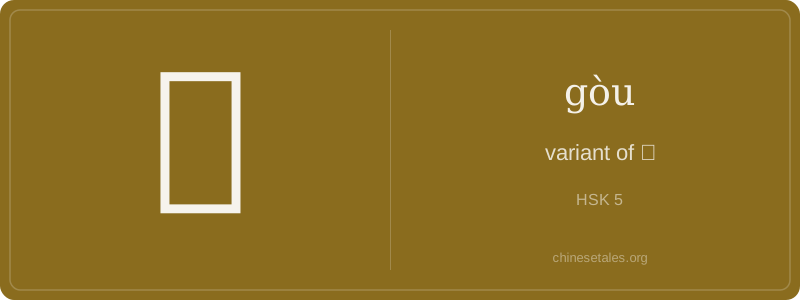
The earliest form of 构 appears in late Warring States bamboo slips — not as a pictograph, but as a deliberate phonetic loan. Its structure is transparent: left side 木 (a stylized tree with trunk and branches), right side 勾 (a bent hook shape, originally depicting a curved tool or finger catching something). In bronze script, 勾 was even more angular — like a shepherd’s crook snagging a sheep. Over centuries, 木 shrank and standardized, while 勾 lost its sharp corner, softening into today’s flowing curve. By the Han dynasty, the whole character had settled into its current eight-stroke balance — clean, compact, and deceptively simple.
This character didn’t evolve from ‘wood + hook’ meaning — it borrowed the sound and visual weight of 勾 to represent ‘sufficiency’, likely because ‘hooking’ implied ‘attaining’ or ‘reaching the needed point’. Classical texts like the *Guangyun* dictionary (1008 CE) list 构 as a variant reading for 够, confirming its sanctioned role in formal writing. Interestingly, Confucian commentaries sometimes used 构 to stress moral adequacy — e.g., ‘his virtue 构仁’ (his virtue reaches the standard of benevolence). The wood radical? A red herring — added only to fit the character into the ‘tree-related’ lexical category, a common bureaucratic sorting trick in ancient dictionaries.
Let’s cut through the confusion first: 构 (gòu) is not the standard character for 'enough' — that’s 够. But in pre-1956 traditional texts, 构 was actually an accepted variant of 够, especially in literary or regional usage. Its core feeling isn’t about building (like its homophone 构 ‘to construct’) — it’s about sufficiency, adequacy, and meeting a threshold. Visually, it’s built from 木 (wood) + 勾 (hook/gou), but this is a *phonetic loan*: the wood radical is purely decorative here — no carpentry involved! The real star is 勾, which supplied the sound gòu and subtly evokes ‘hooking’ or ‘reaching’ — as if you’ve just *hooked* the required amount.
Grammatically, when used as ‘enough’, 构 behaves like 够: it’s a verb meaning ‘to be sufficient’, usually followed by a complement (e.g., 构用, 构格). You’ll rarely see it alone in modern Mandarin — it’s mostly found in classical poetry, old novels, or dialect writing (e.g., Shanghai opera scripts). Learners often misread it as 构 (gòu, ‘to construct’) and blunder into saying ‘the plan constructs the requirements’ instead of ‘the plan meets the requirements’. Context is everything — check for measure words or complements like 得/不 + adjective (e.g., 构不着 = can’t reach).
Culturally, this character is a quiet time capsule: it reveals how Chinese orthography tolerated multiple characters for one word before standardization. Today, using 构 for ‘enough’ will mark you as either quoting Song dynasty poetry or accidentally typing on an antique typewriter. Still, spotting it in a Tang poem or Qing-era letter feels like finding a linguistic fossil — and it’s why HSK 5 includes it: not to use, but to *recognize*.