损
Character Story & Explanation
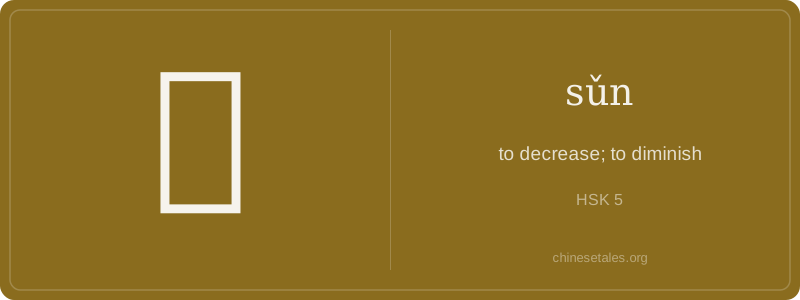
The earliest form of 损 appears in bronze inscriptions around 1000 BCE as a combination of 手 (hand, later simplified to 扌) and 员 (yuán, originally a pictograph of a round coin or disc with a central dot). The hand was shown actively removing or chipping away at the disc — visualizing deliberate reduction, like shaving metal from a coin to devalue it. Over centuries, the round 'coin' evolved into the modern 员 (now meaning 'member' or 'staff'), while the hand radical stabilized as 扌 on the left, and the top stroke of 员 simplified into the horizontal line above the mouth-like component (口).
This origin explains why 损 isn’t just 'loss' — it’s *caused* diminishment. In the Classic of Filial Piety, it warns that neglecting parents '损名' (sǔn míng) — damages one’s reputation — linking moral failure directly to measurable decline. Even today, the character’s shape whispers its history: the hand (扌) literally reaches into the 'circle' (员) and takes something out — not breaking it, but making it less whole, less valuable. That quiet act of subtraction remains its soul.
Think of 损 (sǔn) as the Chinese equivalent of a 'leaky faucet' — not dramatic like a flood, but quietly, inevitably reducing what’s there: value, health, reputation, or resources. It’s rarely about sudden destruction (that’s more 毁 huǐ or 破 pò), but about gradual erosion — like rust on iron, wear on tires, or goodwill fraying over time. In English, we say 'diminish', 'depreciate', or 'impair'; in Chinese, 损 carries that same quiet gravity.
Grammatically, 损 is most often a transitive verb requiring an object ('damage X', 'harm Y'), and it frequently appears in compound verbs (e.g., 损害, 损失) or passive constructions (被...所损). Crucially, it almost never stands alone in speech — you won’t hear '他损了' without context; instead, it’s '损害健康' or '造成损失'. Learners sometimes wrongly use it like the English 'lose' (as in 'I lost my keys'), but that’s 丢 diū — 损 implies agency or causation, not mere misplacement.
Culturally, 损 has subtle moral weight: Confucian texts like the Book of Rites warn against '损人利己' (sǔn rén lì jǐ) — harming others for personal gain — framing diminishment as ethically charged. A common mistake? Overusing 损 where 减 (jiǎn, 'to reduce' neutrally) or 降 (jiàng, 'to lower') fits better — e.g., 'price drops' is 降价, not *损价. Also, 损 is rarely positive: even 'self-criticism' (自我批评) is preferred over *自我损 in formal contexts.