击
Character Story & Explanation
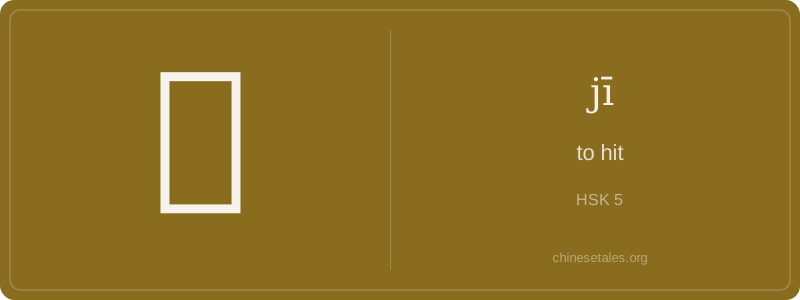
The earliest form of 击 appears in bronze inscriptions as a stylized hand holding a short club or rod, striking downward into a concave shape — the radical 凵 (kǎn), representing a pit, basin, or open container. Over centuries, the hand simplified into the top stroke (a flattened 'L'-shaped hook), the club became the central vertical stroke, and the pit evolved into the open-bottomed 凵 frame. By the Small Seal Script era, the five-stroke structure was fixed: the hook (㇆), the vertical (丨), the dot (丶), the left-falling stroke (丿), and the right-falling stroke (乀) — all arranged to evoke motion *into* containment, like a weapon descending into a target zone.
This visual logic shaped its meaning: not random violence, but *targeted, consequential impact*. In the Classic of Poetry, 击 appears in '击鼓其镗' (jī gǔ qí tāng) — 'strike the drum, thump-thump!' — where rhythm and command converge. Later, in Sun Tzu’s Art of War, 击 becomes synonymous with tactical resolution: '善战者致人而不致于人' ('The skilled warrior draws the enemy in, but is not drawn in') — the 'drawing in' implies setting up the perfect moment to 击. Even today, its shape whispers: *aim, commit, land*.
At its heart, 击 (jī) isn’t just ‘to hit’ — it’s the sharp, decisive *impact* of intention meeting resistance: a drumbeat, a military strike, or even a sudden insight (as in ‘striking’ an idea). Unlike generic verbs like 打 (dǎ), which covers everything from slapping to playing piano, 击 carries weight, precision, and often formality — think battle reports, sports commentary, or academic writing. It’s rarely used alone; you’ll almost always see it in compounds like 攻击 (gōng jī, 'to attack') or 打击 (dǎ jī, 'to strike down').
Grammatically, 击 is almost never the main verb in casual speech — you wouldn’t say 'I hit him' with 击 alone. Instead, it thrives as the second character in two-syllable verbs (e.g., 进击 jìn jī 'to advance and strike', 猛击 měng jī 'to strike fiercely'). It also appears in passive or abstract constructions: 一击即中 (yī jī jí zhòng, 'one strike, immediate hit') — a set phrase praising flawless execution. Learners often overuse it trying to sound formal, but native speakers reserve it for moments that demand gravity or elegance.
Culturally, 击 echoes ancient battlefield discipline — not brute force, but strategic, timed impact. That’s why it appears in martial arts (如影随形,后发先击 — 'like shadow following form, strike first after opponent moves'), music (击鼓 jī gǔ, 'to beat the drum'), and even idioms about intellectual breakthroughs (击节赞叹 jī jié zàn tàn, 'to tap one’s thigh in admiration'). A common mistake? Confusing it with 打 or 易 — but remember: 击 is the *clap of thunder*, not the rain.