挡
Character Story & Explanation
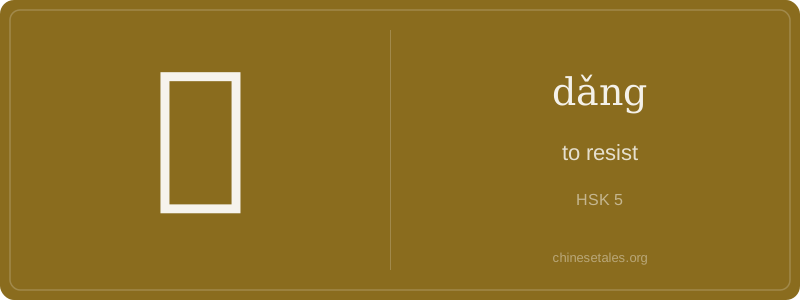
The earliest form of 挡 appears in seal script as 扌 + 当 — not a pictograph, but a phono-semantic compound. The left side 扌 (hand radical) signals action involving the hand or body; the right side 当 (dāng) was both sound clue and semantic anchor — originally meaning ‘to meet head-on’, like two forces colliding. In bronze inscriptions, 当 resembled a stand holding up a vessel, evoking balance and confrontation. Over centuries, the top horizontal stroke of 当 shortened, the crossbar simplified, and the bottom ‘田’ evolved into today’s clean, boxy shape — all while keeping the hand radical firmly on the left, anchoring its bodily, active sense.
This visual logic shaped its meaning: from ‘meeting force with force’ in Warring States military texts (e.g.,《孙子兵法》‘善战者致人而不致于人’ — the skilled commander draws the enemy in, rather than being drawn — implying strategic blocking), to Tang dynasty poetry where 挡 described wind or snow pressing against a cottage door. By the Ming dynasty, it had expanded metaphorically: ‘挡灾’ (ward off misfortune) reflected folk belief that resistance could redirect cosmic forces — a beautiful fusion of physical gesture and spiritual agency.
Think of 挡 (dǎng) as the Chinese equivalent of a bouncer at an exclusive club — not just blocking entry, but actively resisting, deflecting, or holding back pressure. Its core feeling is dynamic opposition: it’s not passive like ‘stop’ (停), but muscular and intentional — like bracing against wind, shielding someone, or refusing a request with quiet authority. You’ll hear it in phrases like ‘挡不住热情’ (can’t resist enthusiasm) or ‘挡路’ (block the way), where the verb implies physical or metaphorical resistance.
Grammatically, 挡 is versatile: it can be transitive (挡雨 — block rain), intransitive (门挡住了 — the door got blocked), or even used in resultative complements (挡住 — to successfully block). A common learner trap? Using it where English says ‘prevent’ — but in Chinese, you’d usually say 防止 or 阻止 instead. 挡 is more about immediate, tangible resistance than abstract prevention.
Culturally, 挡 carries subtle weight: in classical texts, it appears in military contexts (‘挡敌军’) and moral discourse (‘挡诱惑’ — resist temptation), reinforcing the Confucian ideal of self-mastery. And yes — it *can* be pronounced dàng (e.g., in 拾金不昧,拾者当面交还 — archaic usage), but for HSK 5, dǎng is 99% of your needs. Don’t overthink the second reading — just know it exists like a linguistic footnote.