叙
Character Story & Explanation
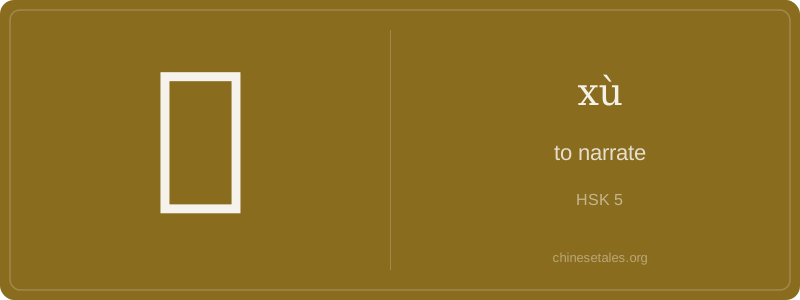
The earliest form of 叙 appears in bronze inscriptions around 900 BCE — not as a pictograph of speech, but as a stylized depiction of a hand (the 又 radical) holding a bundle of bamboo slips tied with string. That ‘bundle’ evolved into the right-hand component (余), originally representing *ordered arrangement*: each slip was numbered, sequenced, and tied — the physical act of composing a record. Over centuries, the knot and slips simplified into the flowing strokes we see today, but the core idea — ‘hand arranging written material’ — never faded.
By the Han dynasty, 叙 had shifted from ‘arranging documents’ to ‘arranging words in time’, gaining its narrative sense. In Sima Qian’s Shǐjì, he opens chapters with 叙曰 ('It is narrated thus'), using 叙 to signal authoritative, chronologically ordered exposition. Confucius himself praised ‘clear 叙’ in ritual texts — not just *what* happened, but *how it unfolds meaningfully*. Even today, the character’s shape whispers this ancient discipline: the 又 hand doesn’t just speak — it *curates*.
At its heart, 叙 (xù) is about weaving meaning — not just telling a story, but arranging events, ideas, or emotions into a coherent thread. It’s less ‘blurt out’ and more ‘thoughtfully unfold’. Think of it as the Chinese verb for *curating experience*: you 叙述 your travel memories, 叙旧 with an old friend (literally 'narrate the past'), or even 叙职 when formally reporting duties — always with intention, structure, and often, emotional resonance.
Grammatically, 叙 is rarely used alone; it pairs tightly with other verbs in compound forms. You’ll almost always see it as 叙述 (xùshù, 'to narrate'), 叙说 (xùshuō, 'to recount'), or in set phrases like 叙旧 (xù jiù). Unlike English 'tell', 叙 carries a subtle literary or formal register — you wouldn’t 叙 your lunch to a coworker at the water cooler (use 说 or 讲 instead). A common mistake? Using 叙 where 说 fits better — over-formalizing casual speech. Remember: 叙 = deliberate, reflective narration.
Culturally, 叙 taps into China’s deep reverence for storytelling as moral and historical anchor — from Sima Qian’s Records of the Grand Historian, where 叙 introduces biographical prefaces, to modern essay contests that reward 'clear 叙事 logic'. Learners also stumble on tone: xù (4th tone) is easily mispronounced as xū (1st) or xǔ (3rd), which changes everything — xū means 'need', xǔ means 'to permit'!