敬
Character Story & Explanation
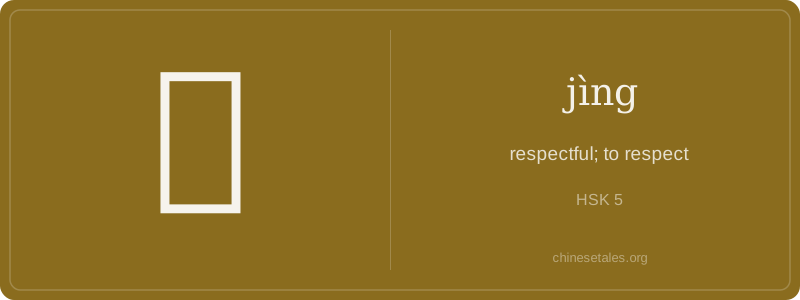
The earliest form of 敬 appears on Western Zhou bronze inscriptions as a composite: a hand holding a ‘bǐ’ (a ceremonial jade tablet) above a ‘kǒu’ (mouth), all under a ‘gān’ (a staff-like symbol representing authority). By the seal script era, the mouth and staff merged into ‘gǒng’ (to clasp hands respectfully), while the hand evolved into the radical 攵 (‘pū’, meaning ‘to tap’ or ‘to act deliberately’). The modern form crystallized in clerical script: the top became ‘gǒng’ (now written as ‘jīng’), and the bottom solidified as 攵 — literally ‘the hand acting with intention’.
This evolution mirrors its semantic journey: from performing ritual gestures with sacred objects → to embodying reverent conduct → to signifying inner moral seriousness. In the Analects, Confucius declares ‘jìng ér wú shī’ (be reverent without error) — linking 敬 to ethical precision. Notice how the character’s visual logic reinforces this: the ‘gǒng’ component suggests clasped hands (deference), while 攵 implies conscious, disciplined action — no accidental respect here. Even today, when someone writes 敬 in calligraphy, the final stroke of 攵 lands with quiet authority, as if bowing at the end of a sentence.
Imagine you’re at a traditional tea ceremony in Suzhou: the host bows slightly, places the cup with both hands, and says ‘qǐng jìng chá’ — ‘please accept this respectful tea.’ That quiet, deliberate gesture? That’s 敬 in action. It’s not just ‘respect’ as a vague idea — it’s reverence embodied: measured movement, intentional silence, honor given *before* it’s earned. Unlike generic ‘zūnzhòng’ (to respect), 敬 carries ritual weight, often directed upward — to elders, teachers, ancestors, or even abstract ideals like ‘jìng yè’ (dedication to one’s work).
Grammatically, 敬 is mostly a verb (‘to respect’) or part of compound nouns/adjectives. You’ll rarely see it alone in speech — it’s almost always in set phrases: ‘jìng ài’ (respect and love), ‘jìng lǐ’ (a formal bow), or ‘gōng jìng’ (courteous, deferential). Learners sometimes wrongly use it as a standalone verb like ‘I respect you’ — but native speakers say ‘wǒ zūnzhòng nǐ’ or ‘wǒ duì nǐ hěn jìng zhòng’, never *‘wǒ jìng nǐ’*. Why? Because 敬 resists casualization — it’s too solemn for daily verbs.
Culturally, 敬 is Confucius’ social glue: it’s the inner attitude that makes hierarchy humane. In classical texts like the Book of Rites, ‘jìng’ is the prerequisite for ritual propriety — without it, bowing is empty theater. A common mistake? Over-translating it as ‘worship’. No — 敬 isn’t religious adoration; it’s dignified recognition of another’s position, virtue, or role. When your Chinese friend says ‘jìng qǐng’ before asking a favor, they’re not groveling — they’re offering gravity to the request itself.