敌
Character Story & Explanation
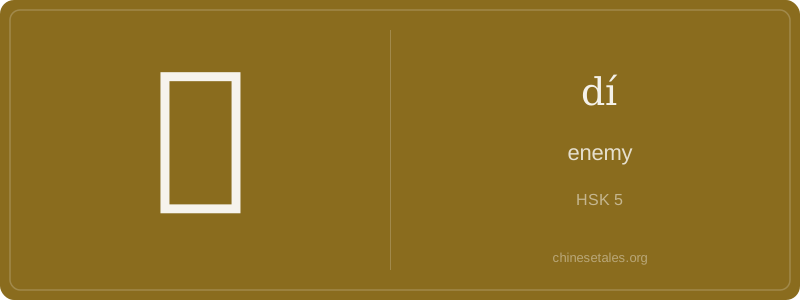
The earliest form of 敌 appears in Warring States bamboo slips—not as a pictograph of a warrior, but as a phonosemantic compound combining 舌 (shé, ‘tongue’) on the left and 帝 (dì, ‘emperor,’ later simplified to ) on the right. Wait—tongue? Yes! In ancient Chinese warfare, ‘tongue’ symbolized speech, command, and authority: the enemy was defined not by face or weapon, but by *who issued counter-orders*. The right side originally resembled 帝 (a ritual jade scepter atop a platform), evoking sovereign power—and thus, a rival sovereign. Over centuries, 帝 eroded into the modern (a stylized ‘upper part’), while 舌 retained its shape, anchoring the character’s identity.
This visual logic persisted: the ‘tongue’ reminds us that enmity begins with rhetoric, proclamation, and declared opposition—not violence first. By the Han dynasty, 敌 appeared in texts like the *Records of the Grand Historian*, describing rival states as 敌国 (díguó, ‘enemy states’). Interestingly, Confucian classics rarely used 敌 for personal grudges; it belonged to statecraft. Even today, its structure whispers an ancient truth: the most dangerous enemy isn’t the one with the sword—but the one who commands, persuades, and defines the battlefield with words.
At its core, 敌 (dí) isn’t just ‘enemy’ in the Hollywood sense—it’s a precise, relational term meaning ‘one who opposes or counters you in conflict,’ whether military, ideological, or even metaphorical (like a disease opposing health). It carries weight: you don’t casually call someone 敌; it implies active antagonism, often institutionalized or systemic. Grammatically, it functions primarily as a noun (e.g., 敌人 rén — ‘enemy person’) or in compound nouns, but crucially, it *never* stands alone as a verb—unlike English ‘to enemy.’ Learners sometimes wrongly say *‘wǒ dí tā’* (I enemy him); instead, use verbs like 对抗 (duìkàng) or 打击 (dǎjī) — 敌 itself stays firmly nominal.
It frequently appears in classical and modern set phrases like 敌强我弱 (dí qiáng wǒ ruò — ‘the enemy is strong, we are weak’), echoing strategic thinking from Sun Tzu’s Art of War. In contemporary usage, it’s common in political, historical, and medical contexts: 癌细胞是身体的敌人 (‘cancer cells are the body’s enemies’). A subtle trap? Don’t confuse it with the homophone 迪 (dí, ‘to guide’) — same sound, zero semantic overlap.
Culturally, 敌 reflects China’s long tradition of dialectical opposition: not just ‘us vs. them,’ but a dynamic relationship demanding vigilance and strategy. This isn’t emotional hatred—it’s analytical, almost clinical. That’s why you’ll see it in neutral terms like 敌情 (díqíng, ‘enemy situation/intelligence’) rather than emotive words like 仇人 (chóurén, ‘bitter enemy’). Misusing it as an adjective (e.g., *‘dí de’*) is a classic HSK 5 error — 敌 has no attributive form; use 敌方 (dífāng, ‘enemy side’) or 敌对的 (díduì de, ‘hostile’) instead.