暗
Character Story & Explanation
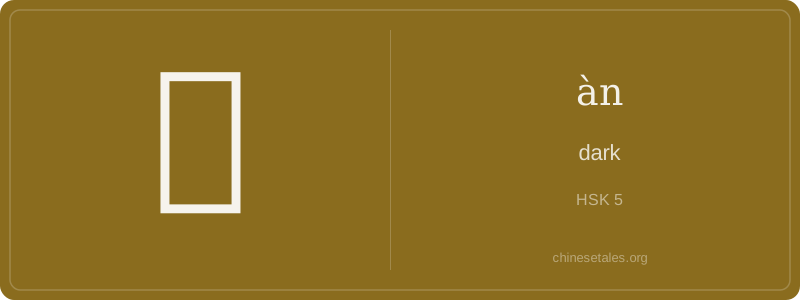
The earliest form of 暗 appears in seal script as a combination of 日 (rì, ‘sun’) on the left and 奄 (yǎn, a phonetic component meaning ‘to cover, to suppress’) on the right — but crucially, the sun is being *smothered*. In oracle bone inscriptions, this wasn’t just ‘no light’ — it was the sun forcibly eclipsed, veiled, or swallowed. Over time, the right side evolved: 奄 simplified into the current 安-like shape (but note — it’s not 安!), while the left 日 retained its sun-box shape. The 13 strokes map this suppression: first the sun (4 strokes), then the covering gesture — five downward strokes in the upper right, two horizontal bars sealing it in, and two final strokes anchoring the concealment at the bottom.
This visual metaphor became semantic truth: by the Warring States period, 暗 meant not only literal dimness but also ‘obscure in meaning’, ‘unenlightened’, or ‘clueless’. Mencius used 暗 to describe rulers who were morally blind — their minds ‘covered’ like the sun. In classical poetry, 暗 often modifies verbs of perception (暗想, àn xiǎng — ‘to secretly ponder’) or movement (暗度, àn dù — ‘to cross stealthily’), reinforcing its core idea: action or thought happening *under cover*, unseen and intentional. The character doesn’t just show darkness — it performs concealment.
Think of 暗 (àn) as Chinese’s ‘no-lights-on’ switch — not just physical darkness like turning off a lamp, but the kind of shadowy ambiguity you’d find in a Hitchcock thriller or a noir detective novel. It’s not neutral absence of light; it’s loaded with secrecy, suspicion, and quiet tension. Unlike English ‘dark’, which can be poetic (‘dark night of the soul’) or even positive (‘dark chocolate’), 暗 almost always implies something hidden, unspoken, or deliberately obscured — like an ‘under-the-table deal’ or a ‘suspicious glance’.
Grammatically, 暗 is refreshingly flexible: it works as an adjective (暗处, àn chù — ‘a dark place’), a verb (暗中, àn zhōng — ‘secretly, behind the scenes’), and even part of compound adverbs like 暗自 (àn zì — ‘to oneself, inwardly’). Learners often mistakenly use it where they need 昏 (hūn, ‘dim, hazy’) or 黑 (hēi, ‘black, pitch-dark’); 暗 isn’t about color or brightness alone — it’s about concealment. You wouldn’t say ‘the room is 暗’ to mean ‘it’s poorly lit’ unless there’s an implication of secrecy or intentionality.
Culturally, 暗 carries centuries of literary weight — from Tang dynasty poets lamenting ‘dark paths’ of exile to modern novels where 暗流 (àn liú, ‘undercurrent’) symbolizes political unrest simmering beneath calm surfaces. A classic mistake? Using 暗 for ‘dark skin’ — that’s 黑 or 褐 (hè); 暗 would suggest someone’s skin is mysteriously *concealed*, not pigmented! Remember: if there’s no mystery, no secrecy, no hidden layer — you probably don’t want 暗.