晒
Character Story & Explanation
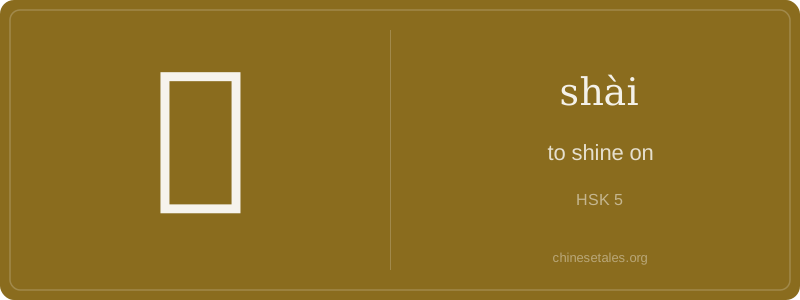
The earliest form of 晒 appears in seal script as a combination of 日 (rì, ‘sun’) on the left and 西 (xī, ‘west’) on the right — but crucially, 西 wasn’t meant as ‘west’ here. In ancient bronzeware inscriptions, 西 was a pictograph of a woven basket, and when paired with 日, it evoked the image of sunlight falling *through* or *onto* a mesh-like surface — think of dappled light filtering through bamboo blinds. Over time, the basket shape simplified into the modern 西, losing its literal basket meaning but retaining the sense of ‘light interacting with material’. The 10 strokes crystallized by the Han dynasty: four for 日 (top-left sun box), six for 西 (a symmetrical, cage-like structure).
This visual logic shaped its semantic evolution. In classical texts like the *Book of Rites*, 晒 described ritual sun-drying of ceremonial grains — sunlight as a purifying, transformative agent. By the Tang dynasty, poets like Bai Juyi used 晒 in lines about ‘sun-drying silk robes’, linking it to care, preservation, and quiet domestic rhythm. The character’s cage-like 西 doesn’t mean ‘west’ — it’s a silent echo of containment and exposure at once: the sun doesn’t just shine; it *selectively illuminates*, like light passing through a lattice. That duality — openness and framing — still lives in today’s digital ‘sun-posting’.
Think of 晒 (shài) as Chinese sunlight’s ‘active verb’ — not just passive light, but the sun *doing something*: shining *on* something with purpose, like a spotlight hitting a stage. Unlike English ‘to shine’, which often implies emission (‘the sun shines’), 晒 always implies direction and contact: the sun shines *onto* a surface, an object, or even a person — and that ‘onto’ is baked into its grammar. You’ll almost always see it with a direct object: 晒太阳 (shài tài yáng, ‘sunbathe’), 晒被子 (shài bèi zi, ‘air out quilts’), or 晒朋友圈 (shài péng you quān, ‘post on WeChat Moments’ — yes, that’s a metaphorical extension!).
Grammatically, 晒 is transitive and rarely stands alone — it craves an object. Learners often mistakenly use it like intransitive ‘shine’ (e.g., *‘今天太阳晒’ — wrong!) when they should say 今天太阳很晒 (jīn tiān tài yáng hěn shài, ‘It’s scorching today’) — here 晒 functions as an adjective meaning ‘intensely sunny’. That shift from verb to adjective? It’s common, but only after the noun (tài yáng hěn shài), never before.
Culturally, 晒 carries warmth, openness, and a touch of exhibitionism — hence its digital slang use: 晒工资 (shài gōng zī, ‘show off one’s salary’) or 晒娃 (shài wá, ‘post baby pics’). But beware: using 晒 for ‘expose’ (as in ‘expose corruption’) is incorrect — that’s 曝 (bào), not 晒. Confusing them is like saying ‘I sunned the scandal’ instead of ‘I exposed it’.