村
Character Story & Explanation
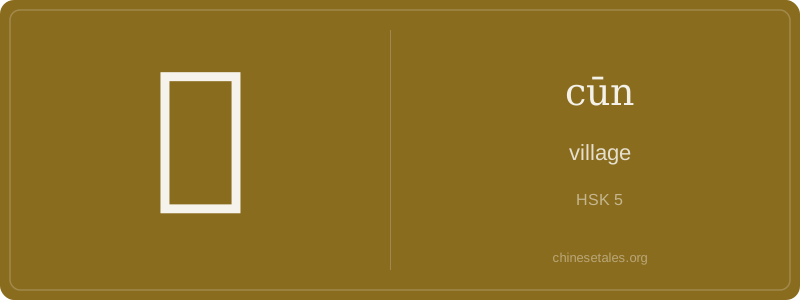
The earliest form of 村 appears in Han dynasty clerical script, not oracle bones — because it’s a relatively late invention. Before the Han, the concept was written as 邨 (an older variant, now rare), which combined 木 (mù, 'tree') on the left and 君 (jūn, 'lord/gentleman') on the right. Scribes later simplified 君 to 屯 (tún, 'to gather, store'), yielding our modern 村: 木 + 屯. Visually, the left 木 anchors it in nature — trees marking boundaries or providing timber — while the right 屯 (7 strokes total, matching 村’s stroke count!) suggests people gathering, storing grain, settling down. Stroke by stroke: first the vertical trunk (丨), then two branches (丿 and 丶), then 屯’s hook-and-curve ( and 乚) wrapping around like arms encircling land.
This visual logic became semantic truth: 村 wasn’t just 'a place with houses' — it was a defended, self-sustaining node where families gathered under shared trees and harvests. By the Tang dynasty, poets like Wang Wei wrote of 'empty mountains and silent villages' (空山不见人,但闻人语响), using 村 to evoke tranquility and human modesty amid nature. Confucian texts emphasized the 村 as the moral bedrock of society — smaller than the state, larger than the family, where virtue was practiced daily. Even today, the character’s tree-rooted shape whispers: no village stands without soil, shade, or shared roots.
At its heart, 村 (cūn) evokes a quiet cluster of homes nestled among trees — not just any settlement, but one rooted in land, kinship, and local identity. The character feels warm, earthy, and slightly rustic; it’s never used for cities or administrative districts, only for organic, human-scaled communities. You’ll rarely see it alone in speech — it almost always appears in compounds like 农村 (nóng cūn, 'rural village') or 村民 (cūn mín, 'village resident'), and never as a standalone noun in formal contexts like 'the village is old' — instead, you’d say 这个村子很老 (zhè ge cūn zi hěn lǎo). That little 子 (zi) suffix? It’s essential: 村 alone feels barebones, almost archaic, while 村子 is the living, breathing word people actually use.
Grammatically, 村 behaves like a countable noun that craves classifiers — usually 个 (ge) or sometimes 个村子 (gè cūn zi). It can’t be pluralized with 们 (men) like people can; you’d say 几个村子 (jǐ gè cūn zi), not 村们. Learners often mistakenly use 村 where they mean 城市 (chéng shì, 'city') or even 镇 (zhèn, 'town') — but 村 implies smaller scale, less infrastructure, and stronger communal ties. Also, watch out: in modern policy language, 村 often refers to an official administrative unit (like a 'village committee'), which may contain several natural hamlets — a nuance lost on many textbooks.
Culturally, 村 carries deep resonance: it’s where ancestral graves are tended, where dialects thrive, and where the phrase 落叶归根 (luò yè guī gēn, 'fallen leaves return to their roots') finds its emotional home. Mistaking it for a generic 'settlement' misses its weight — this is about belonging, not geography. And yes, even tech startups now name products after 村 (e.g., 淘宝村, Táobǎo cūn — 'Taobao villages'), playfully reimagining rural entrepreneurship. That’s how alive this ancient character still is.