析
Character Story & Explanation
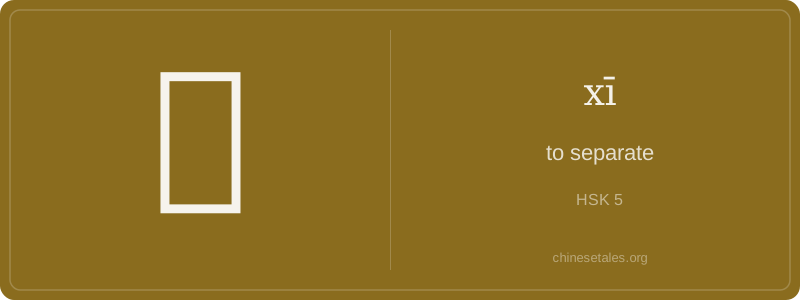
The earliest form of 析 appears in bronze inscriptions around 1000 BCE: a stylized tree (木) with a sharp, diagonal stroke slashing across its trunk — like an axe blade cleaving wood. That diagonal stroke evolved into today’s top-left ‘丿’ (piě), while the lower right became the ‘斤’ (jīn, ‘axe’) component. Crucially, ‘斤’ wasn’t just a sound hint — it was a semantic anchor: in ancient China, axes weren’t tools of destruction, but instruments of precision craftsmanship and ritual purification. The full character thus fused wood (material) + axe (action) = intentional, skillful division.
By the Warring States period, 析 shifted from literal wood-splitting to metaphorical separation — distinguishing truth from falsehood, essence from appearance. Mencius (Mengzi) used it to describe moral discernment: ‘明辨之,笃行之,析其微者也’ (‘Clarity in distinction, steadfast practice — that is how one analyzes the subtlest things’). Its visual logic held: just as an axe reveals wood grain, 析 reveals structural truth. Even today, its strokes mirror this duality — the left ‘木’ grounds it in tangible reality; the right ‘斤’ delivers the decisive, analytical cut.
Think of 析 (xī) as the Chinese equivalent of a forensic scientist’s scalpel: precise, deliberate, and always cutting *into* something to reveal its inner structure — not just splitting things apart, but analyzing by dissection. Unlike English ‘separate’, which can be passive (‘the crowd separated’), 析 implies active, intellectual or physical division — often for understanding, not just distance. It’s rarely used alone; you’ll almost always find it in compounds like 分析 (fēn xī, ‘analysis’) or 剖析 (pōu xī, ‘to dissect analytically’).
Grammatically, 析 never appears as a standalone verb in modern Mandarin — no one says ‘我析这个’ (‘I xī this’). Instead, it pairs with another character to form a two-syllable verb, usually as the second syllable (e.g., 解析, 拆析, 细析). It also appears in formal written contexts — academic papers, legal documents, technical reports — but virtually never in casual speech. Learners often mistakenly use it where 分 (fēn) or 拆 (chāi) would be natural: ‘拆开’ is ‘to take apart physically’, while ‘剖析’ is ‘to lay bare conceptually’.
Culturally, 析 carries a quiet intensity — it’s the character you’d find in Confucian commentary dissecting a single line of the Analects, or in a lab report breaking down spectral data. Its wood radical (木) hints at an ancient origin in woodworking: imagine chiseling grain from timber to study its integrity. A common learner trap? Using 析 in spoken explanations — sounding oddly stiff or even pretentious — when simpler verbs like 说清楚 (shuō qīngchu, ‘explain clearly’) fit better.